Fertilising only when necessary
In agriculture, fertiliser is often added at the wrong time, and in quantities that are too high. A spin-off from ETH Zurich is aiming to help farmers optimise their fields by means of a simple measuring device.
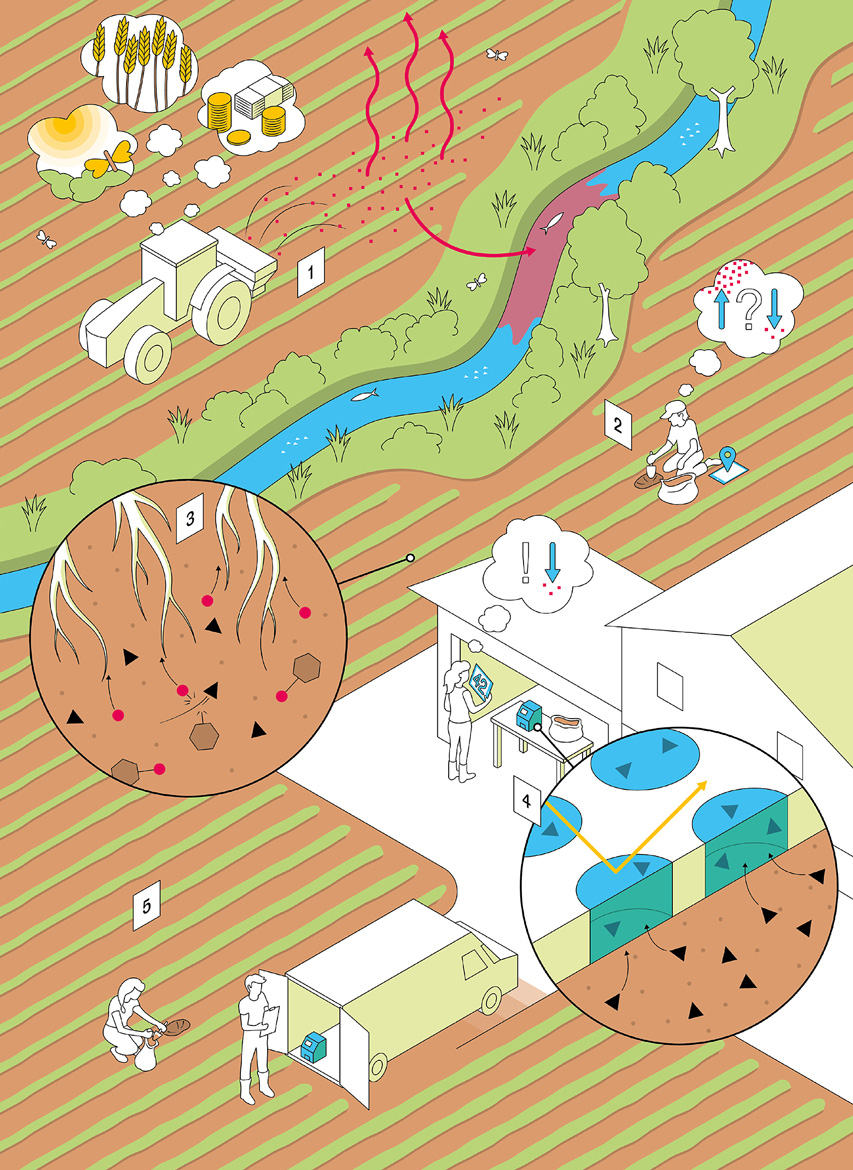
Illustration: ikonaut
The spin-off is already selling the tests to researchers interested in enzyme activity in their soil. It is also producing reports for farmers on optimal fertiliser use. In 2025, the app, test and reports should all be ready for use on farms.
Back on the farm, the farmers can analyse a soil sample with a measuring device developed by the spin-off. It comprises a card with holes filled with a special gel that they then press onto the soil sample. The enzymes in the soil pass through a membrane into the gel and come into contact with its chemicals. The measuring apparatus employs an optical method to determine how strongly the enzymes react with the chemicals. The app combines the resultant data with information on the soil composition and weather forecasts to recommend the correct use of fertiliser.
3 — Enzymes release nutrients
Bacteria, fungi, roots and small creatures in the soil secrete enzymes that break down organic material such as manure. This produces nutrients (i.e., fertiliser) from which the plants also benefit. If you know which enzymes are currently active in the soil, you can predict the development of soil fertility.
2 — Helping crop cultivation
Digit-Soil, an ETH Zurich spin-off, has developed a method for measuring the composition of the soil on the spot, and deciding whether fertiliser is needed. An app guides the farmer to where they should take a soil sample.
1 — The problem of over-fertilisation
If arable crops are to grow well and produce plenty of food, they need nutrients in the form of fertiliser. But if too much is applied, or at the wrong time, or of the wrong type, this can damage the environment and entail extra costs for farmers.