Out of the depths
Descending into the narrow, slippery passages of the Grotte de Milandre in the Jura is dangerous. Nevertheless, researchers from the University of Bern venture there in order to take measurements that can help them study the long-term effects of climate change.
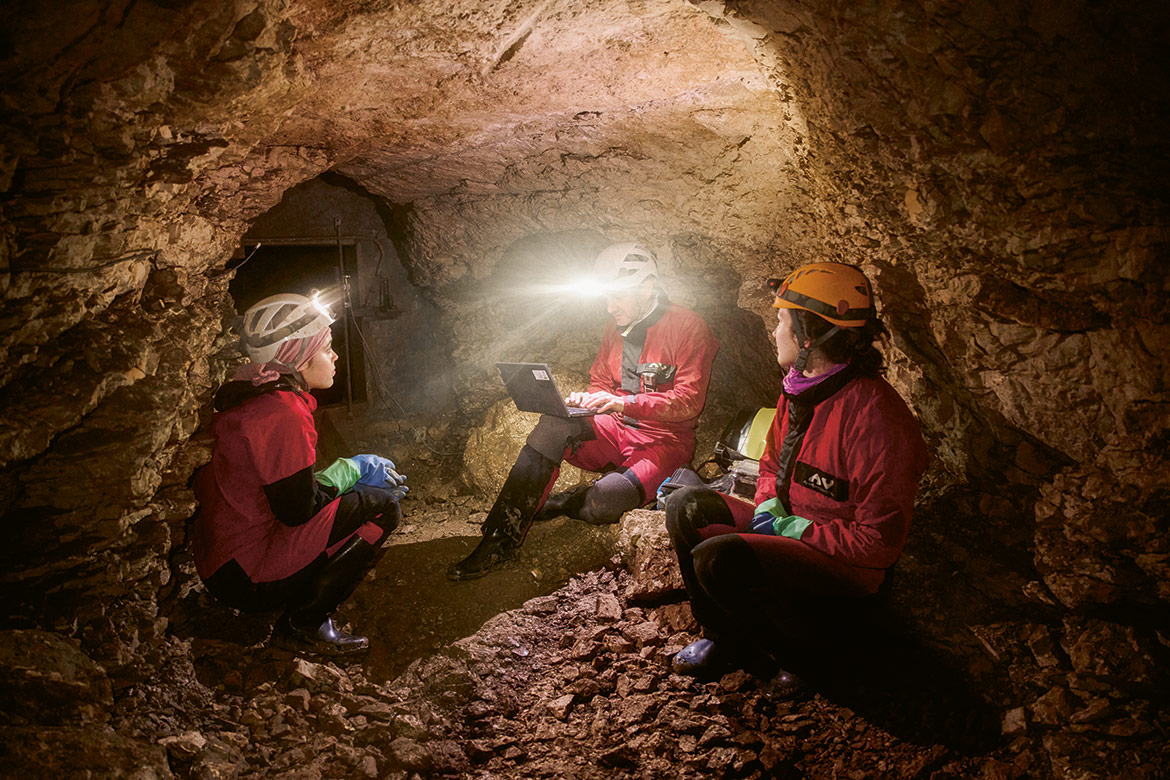
Pausing in the dark: Deep in the Grotte de Milandre, the research team transfers data from a measuring device to a laptop. | Photo: Gian Marco Castelberg
The concrete hut with its rusted iron door stands on its own in the forest, quite out of place. It opens onto a similarly concrete corridor and then a staircase that leads steeply downwards. To a layperson, it looks like a gateway to the underworld. But for Franziska Lechleitner, a geochemist and climate scientist at the University of Bern, it opens up onto a treasure trove of knowledge.
This initially awe-inspiring abyss bears the name of Grotte de Milandre – the Milandre Grotto. It’s to be found just outside the tiny town of Boncourt at the north-western tip of Switzerland, next to the border with France. It’s the site of the best-studied stalactite cave in Europe, whose dripstones bear within them the climate history of the last 100,000 years. “It’s my task to try and extract this information from the stone and reconstruct the climate of the past”, says Lechleitner. “Ultimately, this will also help us to understand the environmental shifts we’re facing today in a time of climate change”.
But these caves don’t willingly reveal their secrets. Kitted out with helmet, a head torch and a waterproof suit, Lechleitner proceeds on all fours, squeezing through passages barely half a metre high. The earth beneath us is pure clay and acquires a greasy, soap-like consistency when water drips onto it. It’s par for the course that a research expedition here will cover you in brown clay from head to toe.
But this is the harmless bit. Caves are also dangerous places to work. If anyone slipped on these moist stones and broke their leg, they’d be stuck down here, and it would take a lengthy rescue operation involving dozens of helpers to get them back up to the daylight again.
When CO2 reaches two percent: get out!
This is why Lechleitner is accompanied by her doctoral student Sarah Rowan, who’s researching into climate science, and Marc Lütscher, a palaeoclimatologist at the Swiss Institute of Speleology and Karstology (SISKA). He’s responsible for coordinating the research activities of different universities down here. For this particular tour, he’s wearing a warning device for CO2. “The gas can sometimes rise quickly. If it reaches two percent, we’ve got to get out. Above three percent, it’s life-threatening”, he says. But right now, the needle’s still in the green zone.
Today, their aim is to collect samples of water and air. After proceeding for a quarter of an hour, Lechleitner reaches a small stalactite the size of a pig’s tail. Every second, a drop of water falls from its tip. Lechleitner holds her sample tube underneath it and fills it up. “This water contains the chemical fingerprint of today’s environment”, she says.
In order to understand this, you have to visualise the path of just such a water droplet. It emerges in a cloud in the sky then falls downwards, absorbing carbon dioxide from the atmosphere as it does. Some of it remains captured as a gas in a dissolved state. Another part of it is converted into carbonic acid. Finally, the droplet hits the ground and starts to seep through the soil.
Contaminating breath
Further carbon dioxide comes from the breathing activities of plant roots, bacteria, fungi, worms and other organisms in the soil. The water drop develops a little more carbonic acid. Then it reaches the bedrock, here the Jurassic Limestone. “The acid reacts with the limestone and dissolves it. This is the process that created this cave in the first place”, says Lechleitner. Finally, the drop seeps through one of the innumerable cracks in the rock, into the interior of the cave. It first slides down the stalactite hanging from the ceiling, then lands on the stalagmite below, where the carbon it has collected during its journey is precipitated as lime. What was before a mixture of carbon dioxide gas, carbonic acid and lime turns into stone.
Rowan, the doctoral student, is now busy with an elongated balloon. It’s time to take the first air sample. She kneels in a narrow gallery of the tunnel where a mild wind is blowing. This is because the air in the cave is warm at ten degrees Celcius, and rises here just like in a chimney. Cold winter air then flows in from the outside, where it’s zero degrees.
Rowan attaches her balloon to a tube that leads a few metres away from her. She explains why: “I don’t want to contaminate the air collected here with the air I breathe out”. As an additional precaution, she also stands downwind while taking the sample. The balloon can hold five litres of air and is made of thick plastic so that it will survive the journey back up to the surface.
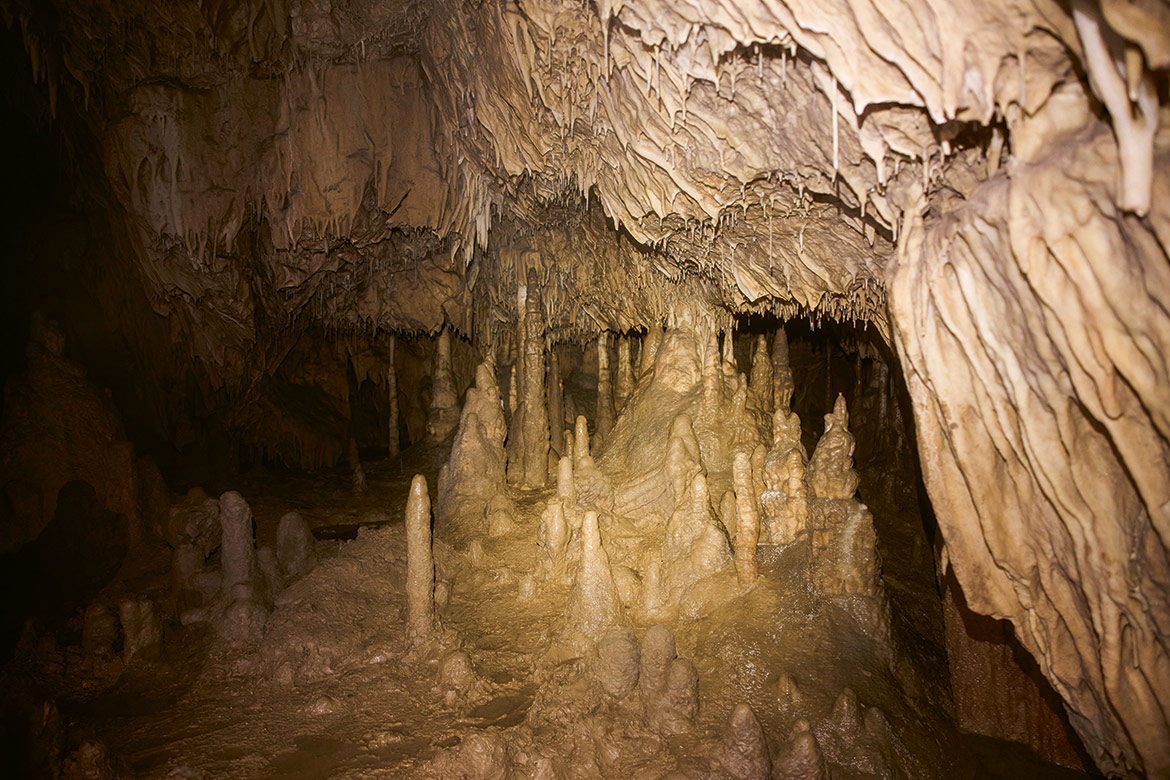
Stalagmites grow upwards, while stalactites hang from the ceiling: The Milandre Grotto near Boncourt (JU). | Photos: Gian Marco Castelberg
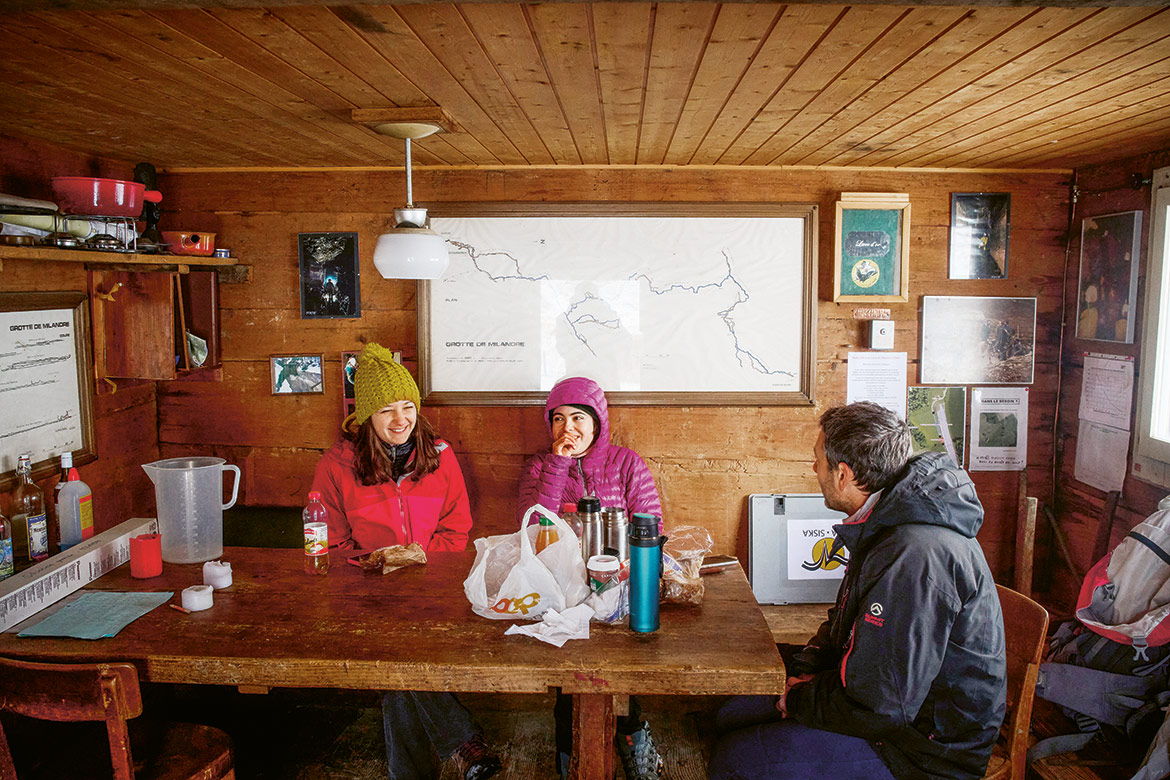
The researchers eat lunch in a hut next to the Grotto’s entrance. A map of its underground passages hangs on the wall behind them.
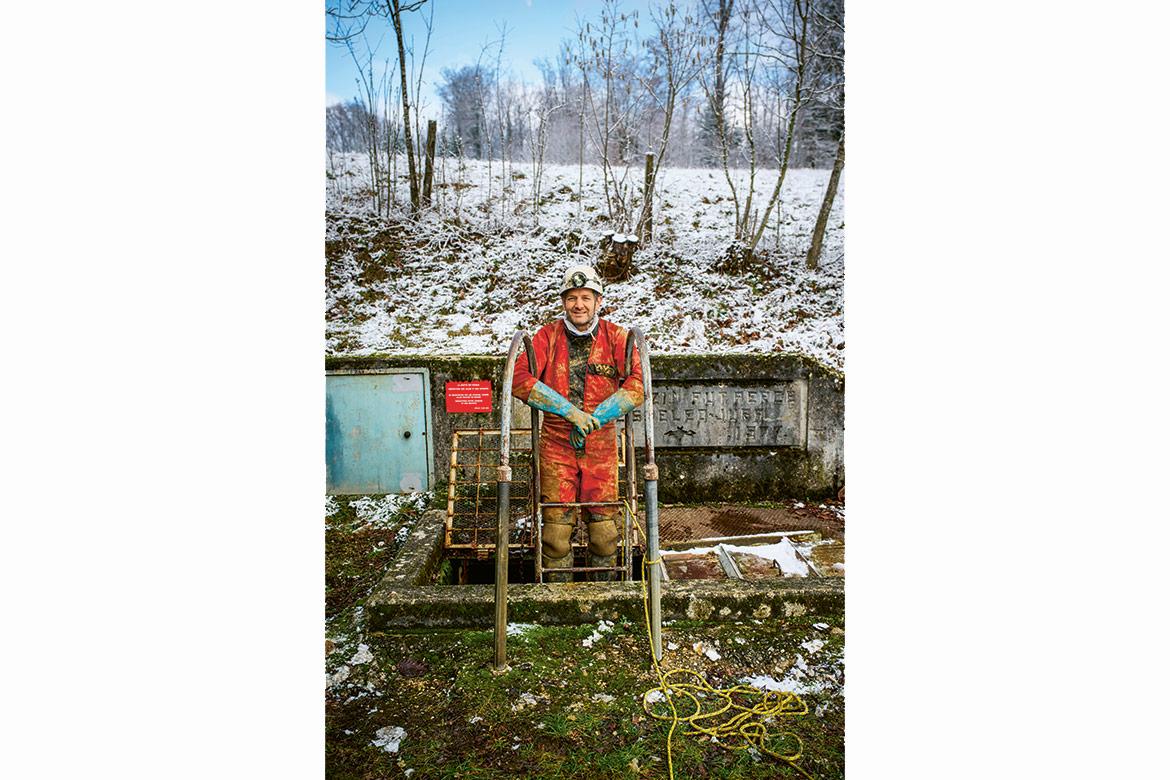
Marc Lütscher is a palaeoclimatologist at the Swiss Institute of Speleology and Karstology. He’s getting ready to go into the Grotto.
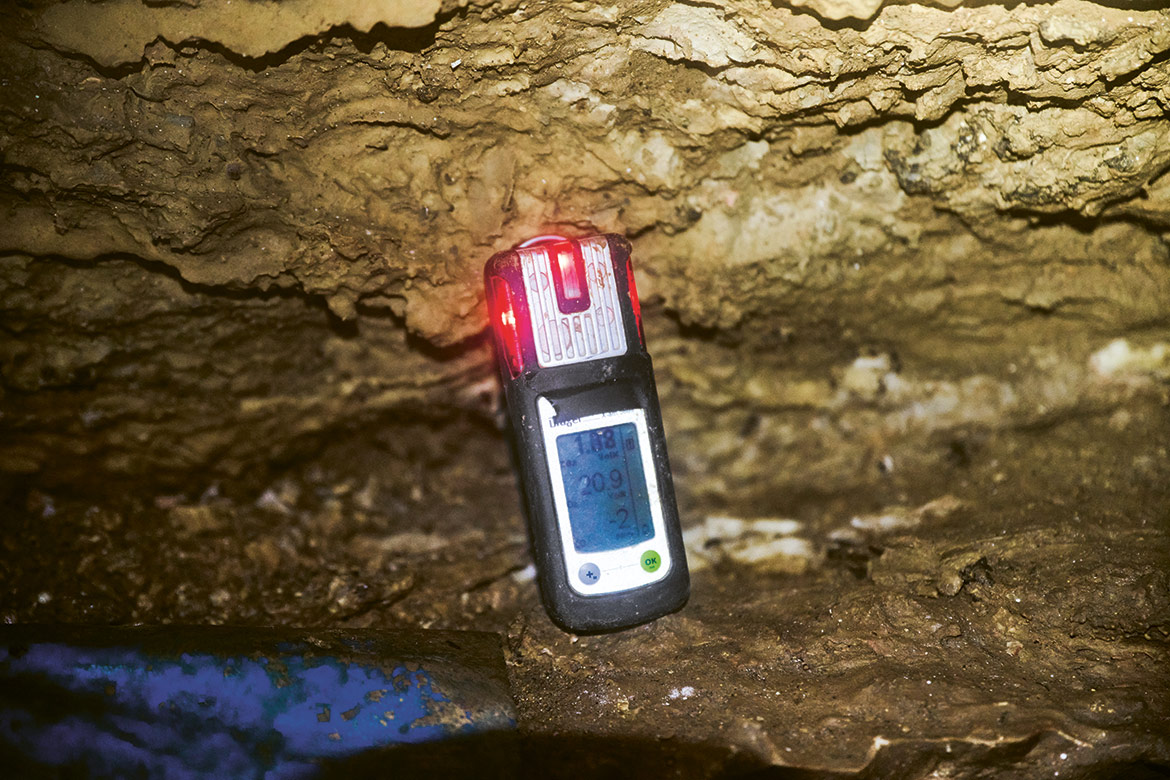
Vital for survival: This measuring device has just sounded the alarm because the CO₂ concentration is too high.
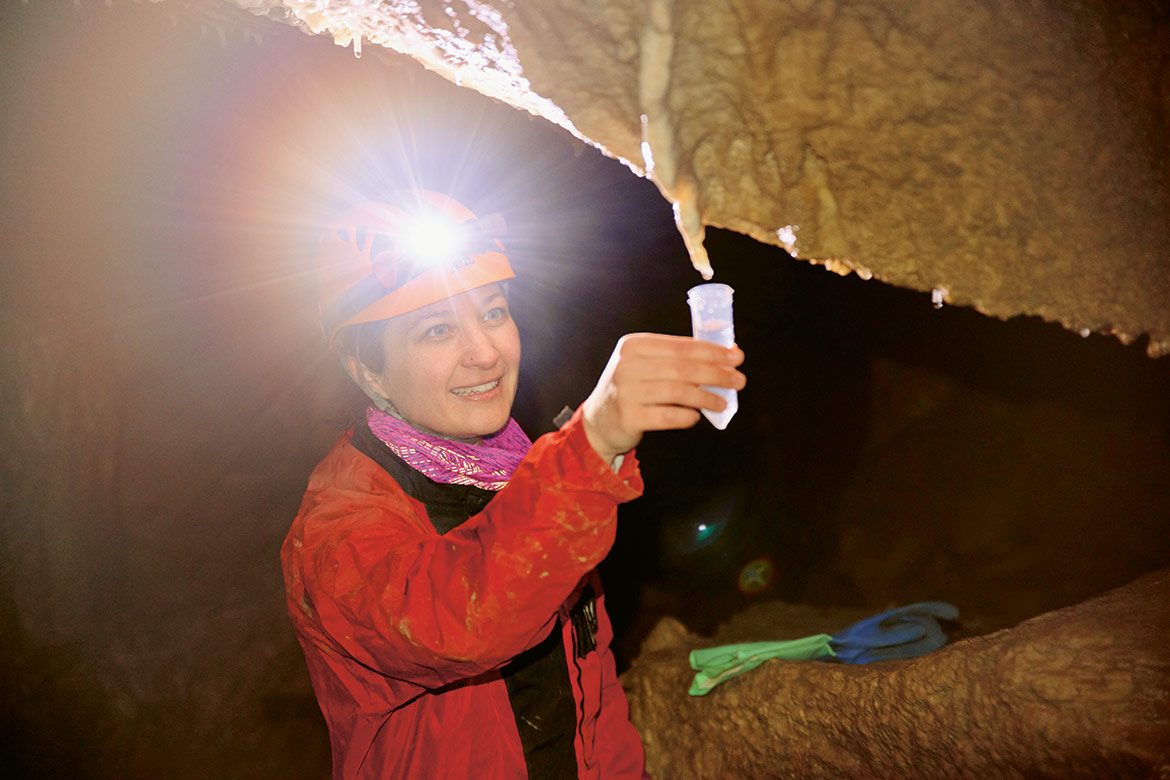
Franziska Lechleitner, a climate scientist at the University of Bern, is taking a water sample from a stalactite.
The air in the cave also influences the chemical composition of the water droplets. Later on, outside the cave, the researchers will take further samples of water and air from both the soil and the Jurassic Limestone. “We can compare these samples back in the lab”, says Lechleitner. “That way we can find out what happens to the chemical composition of the air and water on their way into the cave”.
Measuring time with carbon
She’s especially interested in the carbon. Some of it consists of radioactive carbon-14 (C14), which is often used by archaeologists for radiocarbon dating. It’s formed in the upper atmosphere through cosmic radiation. When it’s embedded in wood, limestone, bone or other materials, it has a half-life of 5,730 years and continues decaying until there’s nothing left of it. It’s like a natural clock that indicates the age of objects. The carbon from the atmosphere turns into the lime that forms the stalagmites. “By analysing the C14, we can determine the age of the carbon in the stalagmite in different phases of its growth”, says Lechleitner.
But that alone tells us nothing about the climate. “This is why we keep an eye out for temporal anomalies”, she says. There are certainly plenty of them, because determining the age of a stalagmite using C14 always makes it seem older than it really is. Lechleitner knows this, which is why she also uses other methods to measure the age of the stalagmites, based on the radioactive decay of uranium and thorium. That way, she has two ‘clocks’ that she can compare with each other.
The differences between the two methods depend on the climate in different epochs. “If the climate was rather cool”, she says, “then the carbon will have spent a longer time in the cycle of nature before it was stored in the stone”. We should imagine an icy landscape in which water only sporadically melts and seeps into the ground. “During this time, the C14 is constantly breaking down”, says Lechleitner. This means that less C14 will ultimately be stored in the stalagmite, which makes it seem older than it is. “When the climate is warmer, the water seeps away quicker and the C14 becomes part of the stalagmite after just a few days”. In such cases, there is greater alignment between her two clocks.
At the moment, trying to extrapolate information about the state of past ecosystems using today’s measurements is still a rather vague science. “That’s why we take water and air samples. We compare the measurements with today’s climate data to see how the climate and water chemistry are related to each other”.
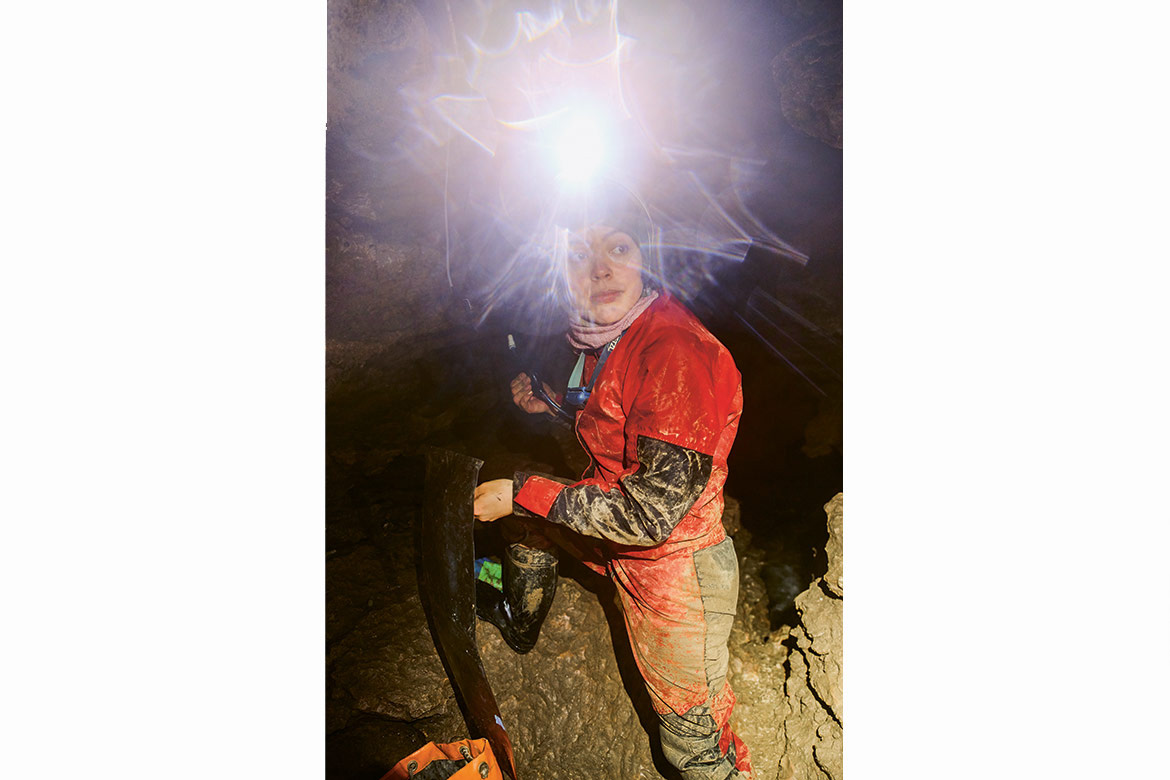
Sarah Rowan, a doctoral student, is using a special balloon to take a sample of air from the cave. | Photos: Gian Marco Castelberg
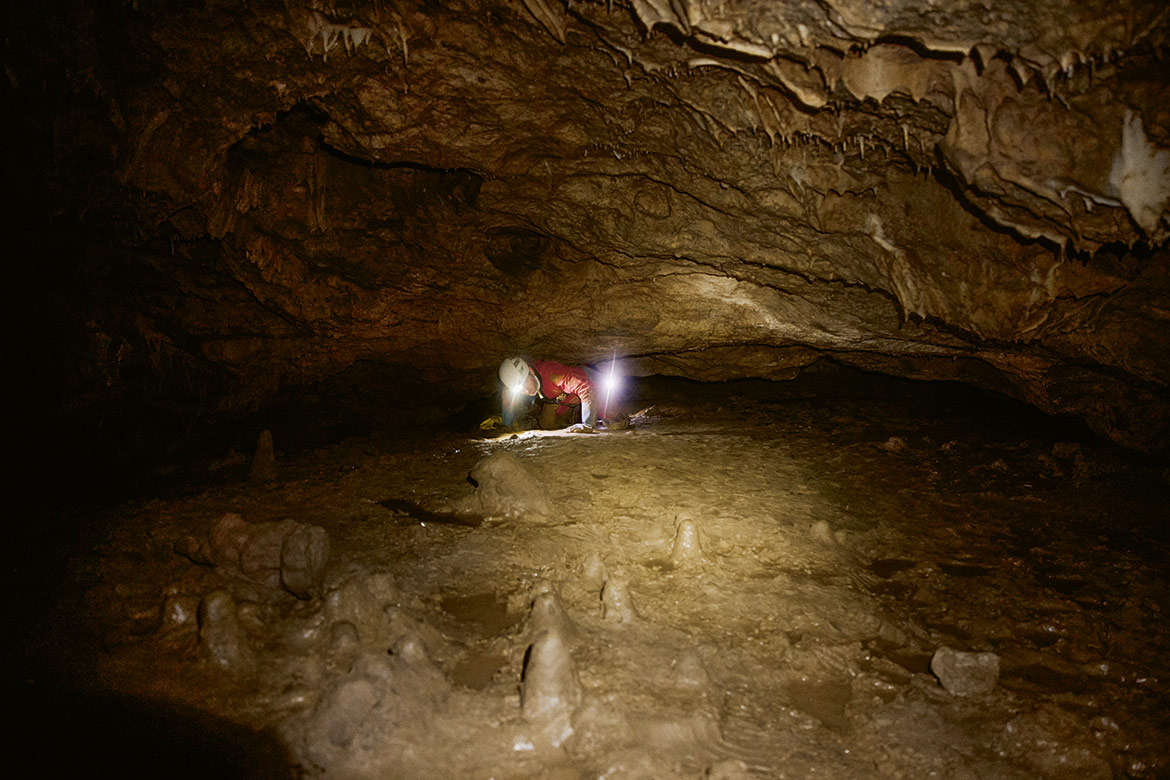
At some places in the Milandre Grotto, you can only proceed on all fours.
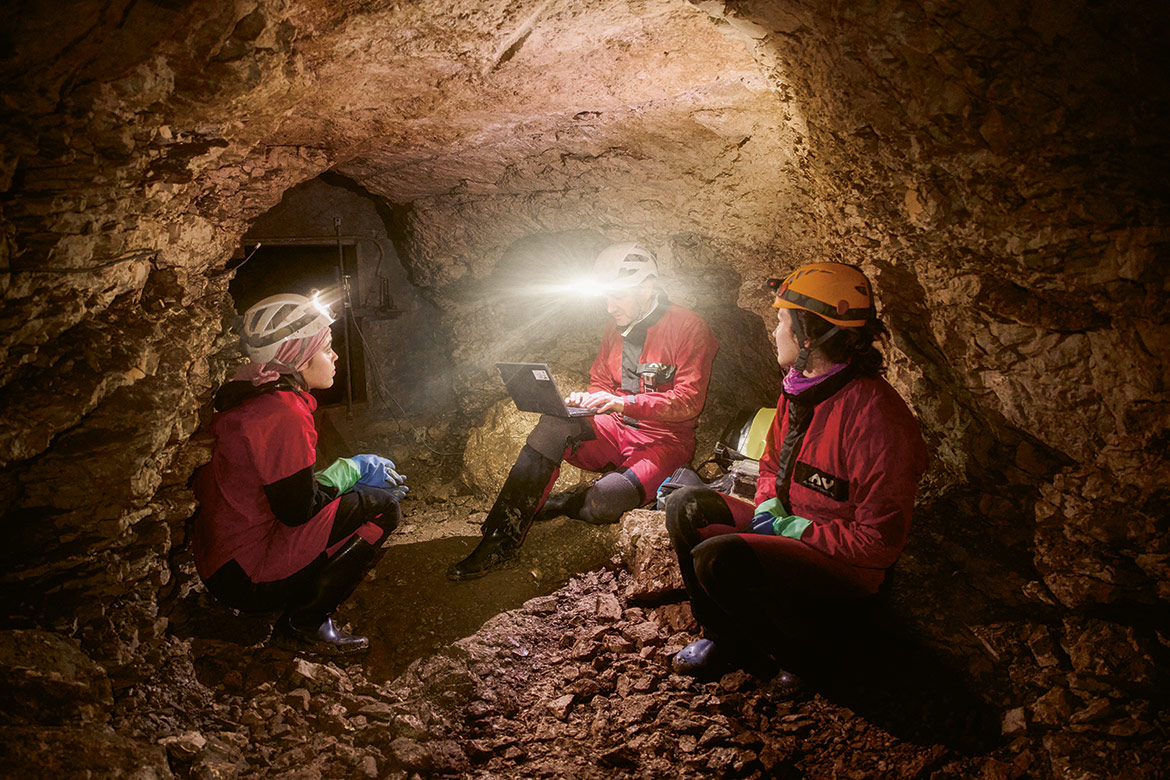
Just another daily chat in their underground office.
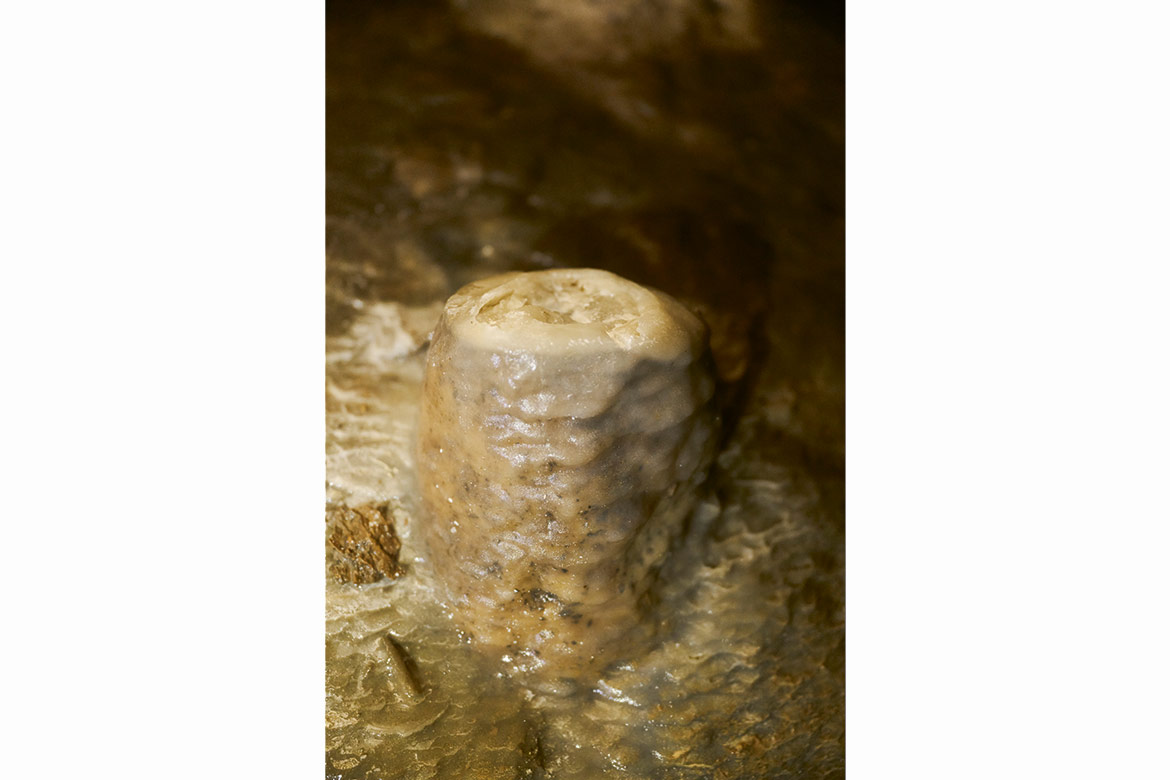
Project manager Lechleitner broke off the tip of this stalagmite to investigate climate fluctuations. But she does this very rarely: When something’s grown for thousands of years, it’s better to leave it alone.
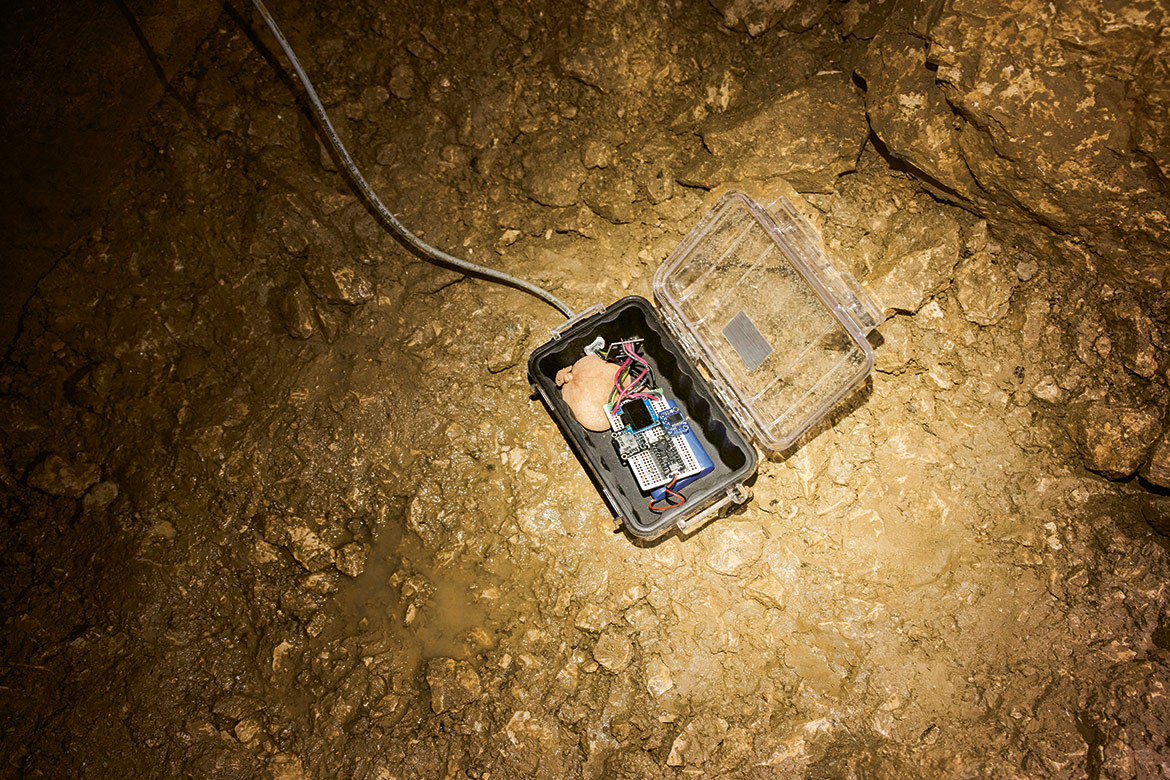
The temperature logger and its battery remain below ground. Everything has to be watertight, as the cave is sometimes completely flooded.
The gas warning device starts to howl. The CO2 content of the air has reached 1.7 percent – already over 40 times more than in the air outside. “That’s still okay”, says Lütscher calmly. The alarm is just a reminder that the work down here is dangerous and that you have to keep your mind focussed on the job.
They’re not taking any rock samples today. In any case, they have to proceed cautiously. “Sampling stalagmites is a highly emotive topic. Many people say we shouldn’t be damaging anything at all”, says Lütscher. Legally, it’s in a grey area. To be sure, if anyone wants to extract a stalagmite sample, they don’t have to file it with an ethics committee – they are responsible only for living organisms. “Legal guidelines are currently being formulated in several cantons to ensure that caves and other geological outcrops are better protected”, says Lütscher. Lechleitner adds: “Overall, there’s too little awareness that these are places worth protecting. If we change anything here, we’re destroying something that needed thousands of years to grow”.
Don’t break the stalagmites
On one occasion, Lechleitner had to break off a tiny stalagmite for her work, as it was essential for determining its age. Removing it isn’t time-consuming – all you need is a hammer and a chisel. “We always try to collect as little as possible”, she says. This cave is an archive of knowledge in stone form, and their prime concern is to preserve it for future generations of researchers. One day, it might even be possible to read much more from these stones than just the climate of times long past.