Young opinions
“Regrettably, something really bad usually has to happen”
The Swiss historian Fabian Baumann maintains that the field of Eastern European history has always been heavily influenced by political developments. He explains how the war between Russia and Ukraine is impacting his work.
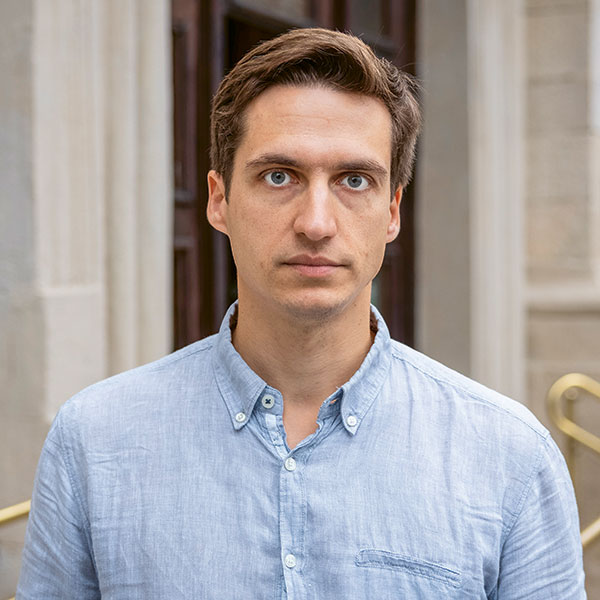
Fabian Baumann is based at the University of Heidelberg and is researching into nationalism and imperialism in Russia, Ukraine and eastern Central Europe. | Photo: Katya Moskalyuk
Fabian Baumann, people today are suddenly interested in your work as a historian of Eastern Europe. What questions are they asking?
They most frequently ask for an assessment of the current situation in Ukraine. I’m also often asked about whether I think the media offer a fair overall picture of the war.
And what do you tell people?
On the whole, the Swiss media are reporting pretty fairly. But certain subtleties in the historical relationship between Russia and Ukraine could be better depicted.
For example?
An independent Ukraine has long been a spectre for the Russian state. It’s repeatedly resorted to brutality in its attempts to suppress national movements there. For example, it practically banned the public use of the Ukrainian language in the 19th century. And in the 20th century, the Soviet Union employed massive violence against Ukrainian peasants. Nevertheless, the two peoples themselves were never enemies. On the contrary, there was always a lot of contact between them, with many mixed marriages.
Your field has grown in relevance.
Yes. Regrettably, something really bad has to happen for the public to want more basic historical knowledge about these things. We have also noticed that university students are becoming increasingly interested in Ukrainian history.
Some people are calling for a ‘postcolonial turn’ in your discipline. What would that actually mean?
For example, that we shouldn’t rely on the Russian language alone, but that we should definitely learn a second regional language, whether it be Ukrainian, Georgian or Uzbek. Nor should the Russian state archives be our only sources. In recent years, historiography has been very critical of nationalist myths, but less so of imperial myths.
What do you mean by that?
There was more interest in those who had joined the Soviet project, and less in those of the nationalist resistance. But the Soviet Union was a violent, imperial regime, especially on its periphery, as in Chechnya, for example. We also shouldn’t lose sight of the fact that many people approved of the Soviet Union.
Has the Russian invasion led to any rifts among your colleagues?
There is certainly potential for conflict, but it doesn’t have the same divisive energy as, for example, the situation in Israel and Gaza when it comes to the field of Middle East studies. Very few Western historians of Eastern Europe are actively defending the Russian position in the war. But when it comes to implementing the postcolonial turn, or how much we should be de-centring Russia in the field, there are already differences of opinion.