Feature: A long life
Extraordinary tales of animal longevity
Some fly millions of kilometres, while others have been swimming in our oceans or defying the elements for centuries. We’ve been investigating some of the world’s most astonishing ancient life forms.
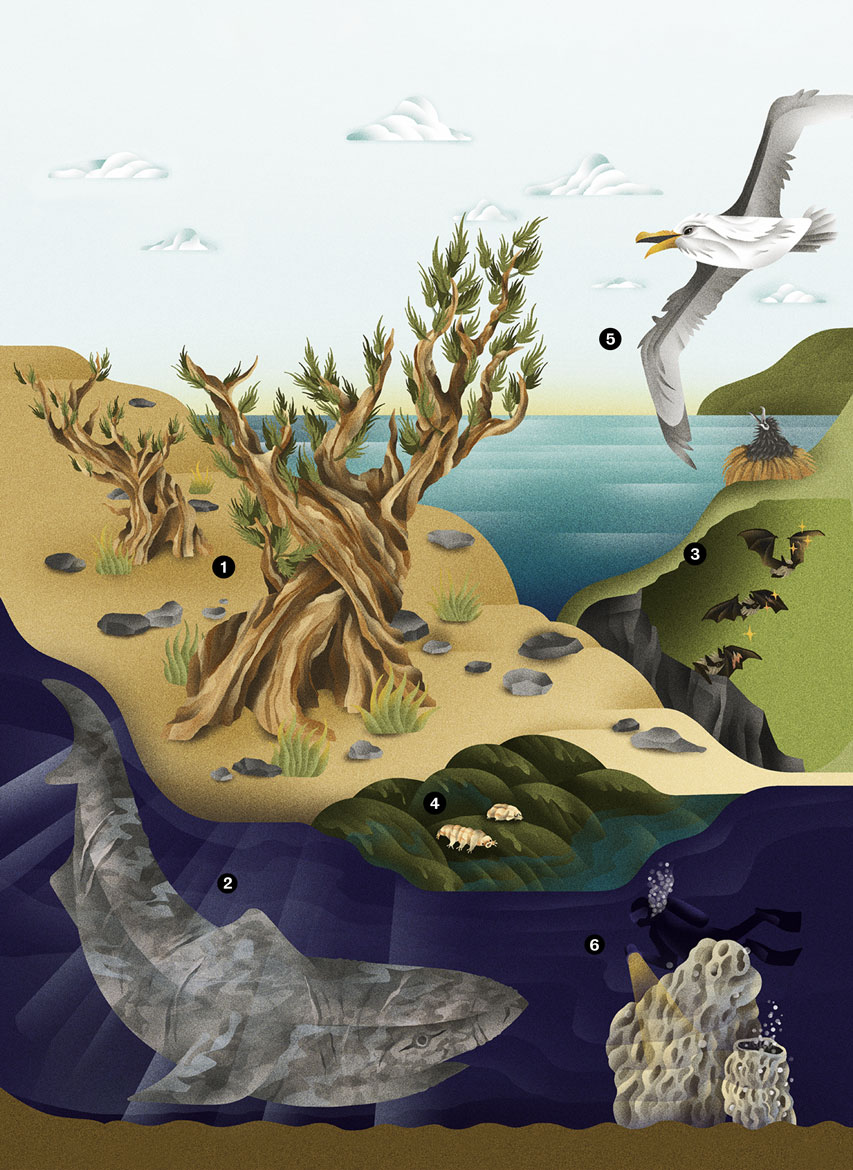
Illustration: Melanie Grauer
6 — Giant sponge needs little oxygen
The oldest documented animal in the world is a specimen of the giant volcano sponge Anoxycalyx joubini that’s over 10,000 years old. We know this thanks to measurements of its oxygen content – the older the sponge, the more oxygen its tissue contains. This sponge has a diameter of some two metres and lives anchored to the bottom of the Antarctic Ocean. These creatures probably grow so old because they survive on little oxygen and their metabolism is massively slowed down. There’s another bizarre aquatic animal – the jellyfish Turritopsis dohrnii – which is theoretically even immortal. Its two life stages, as polyps anchored to the seabed and as free-swimming jellyfish, are genetically identical. But unlike other jellyfish, T. dohrnii can produce new polyps when stressed. In principle, these animals can proceed through this life cycle of polyp-jellyfish-polyp as often as they like.
5 — Albatrosses breed at 75
Some birds can also get very old. Common ravens live to be over 30, some parrot species over 60. The oldest confirmed wild bird is a female Laysan albatross that lives on the Midway Atoll in the middle of the Pacific that’s come to be known as ‘Wisdom’. She was first ringed in 1956, when she was reckoned to be about five years old. She’s now 74 and is still breeding: her latest healthy chick was hatched in late January 2025. This made Wisdom a star, with innumerable photos, media reports and TV programmes spreading her fame around the world. Incidentally, she’s estimated to have flown almost five million kilometres over her lifetime – that’s equal to travelling 125 times around the globe.
4 — Tardigrades halt their metabolism
Tardigrades are tiny, but live an incredibly long time for a creature of their size. They are smaller than a millimetre but live for up to two-and-a-half years, depending on their species. What’s more, these animals are also virtually indestructible. When placed under stress, they change into a resistant form known as their ‘barrel stage’. They curl up and place their metabolism at a standstill. This enables them to withstand drought, extreme cold, radiation and even space travel. When environmental conditions become more favourable again, the tardigrades return to their normal form and continue to live as if nothing untoward had happened. A study published in 2016, for example, documented how tardigrades are able to revive themselves and reproduce after 30 years of metabolic standstill.
3 — Rejuvenating bats
Small animals live significantly shorter lives than large ones. That’s perfectly understandable from an evolutionary point of view, because keeping body cells fit – and therefore lengthening lifespan – costs energy. The bigger the risk that an animal species will early on become prey for another, the less worthwhile any efforts at longevity. For example, mice only live for two or three years, deer can live to the age of about 15, but elephants up to 70. All the same, there are exceptions to the rule. One of the most striking is the bat. The oldest bat known to us was a specimen of ‘Brandt’s bat’ that weighed less than ten grams and lived to be at least 41. “If you take its body size into account, this equates to around 250 human years”, says Emma Teeling, who’s a researcher at University College Dublin. The effort required to live a life as long as this is considerable – but it’s worthwhile since bats can fly away from most predators. “To achieve this longevity, the animals have to be able to repair molecular damage that accumulates in their cells over time – such as damage to their proteins or their DNA”, says Teeling. In her research on mouse-eared bat colonies in France (the genus to which Brandt’s bats belong), she discovered that these molecular repair processes don’t dwindle with age, as is the case with other species, but instead become stronger.
2 — The shark that stayed out in the cold
According to current knowledge, the longest-lived mammals are the bowhead whales, which can live to be over 200 years old. They possess an unusually active DNA repair mechanism that is probably one reason for their longevity, as it slows down the accumulation of damage in their genome. But the Greenland shark lives even longer. “This species is the longest-living vertebrate in the world”, says John Fleng Steffensen, a marine biologist at the University of Copenhagen. In a study published in 2016, Steffensen and his research team determined the ages of 28 specimens of Greenland shark that fishermen had pulled out of the Arctic Ocean off Greenland and Svalbard as bycatch.
The researchers were amazed when the oldest of these animals – a female five metres long – turned out to be some 400 years old. This can only mean that these animals grow extremely slowly. Steffensen and Co. were also able to use their data to estimate that these sharks only reach sexual maturity at the age of about 150. “One reason for this slow ageing process could be the fact that they live in the depths of the ocean where the water temperature is between minus 1.8 degrees Celsius and plus 8 degrees”, says Steffensen. The Greenland shark is a cold-blooded animal that adapts its body temperature to its icy environment. This slows down its metabolism, meaning it essentially lives its life in slow motion. We also know from a study conducted in 2024 that genes related to DNA repair are duplicated in the Greenland shark’s genome.
1 — Methuselah pine braves all elements
If anyone’s asked to name a long-lived tree, most will probably think first of the giant redwoods. And it’s true that they can reach a ripe old age, for the oldest specimens in the Sierra Nevada in California have been standing there for over 3,200 years. But there are Great Basin Bristlecone pines in the White Mountains of California that are even older. The oldest documented specimen, aptly nicknamed Methuselah, is no less than 4,850 years old. These Great Basin Bristlecones are also considered to be the longest-living non-clonal trees in the world – in other words, they are trees whose trunk and crown have truly withstood the wind and the weather for thousands of years, and haven’t just remained genetically the same. Clonal trees can in fact grow even older – such as Old Tjikko, a common spruce in the Fulufjället National Park in Sweden. Although it renews its trunk every 600 years, its root system is some 10,000 years old.