PORTRAIT
Lady scientist on fire
Annalisa Manera is a nuclear researcher who wants to de-emotionalise nuclear energy – whether it’s to be used for the energy transition or for future missions to Mars. She sometimes causes others offence in the process – but she takes it all in her stride.

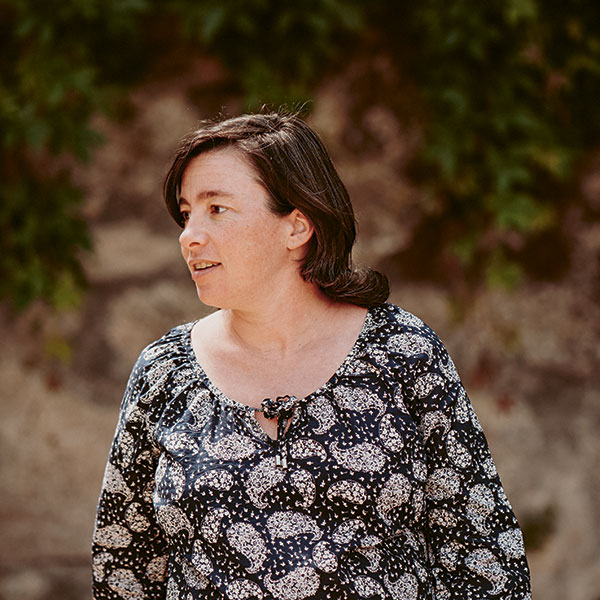
Annalisa Manera, a professor at the Nuclear Systems and Multiphase Flows Laboratory at ETH Zurich, is convinced that nuclear engineers will be in demand for a long time to come. | Photo: Maurice Haas
“I’m radioactive. You’re radioactive. Our food is radioactive!” Annalisa Manera pours all her fiery Italian temperament into her arguments. “Radioactivity occurs in nature. But most people are unable to assess it. This is a way to fuel their fears”, she says emphatically. She’s a nuclear researcher at the Paul Scherrer Institute (PSI) and a professor at the Laboratory of Nuclear Systems and Multiphase Flows at ETH Zurich. She then offers a succinct example: “The Fukushima water that’s been discharged into the sea for the past two years has caused an uproar with everyone. But if you drank four litres of it, you’d absorb the same dose of radiation as if you’d eaten a single banana!”
Manera has repeatedly campaigned in the media for the use of nuclear energy. Radioactivity is dangerous at a high level, of course – but it’s also useful. In medicine, it helps to destroy tumour cells. And it’s making an important contribution to decarbonising our electricity mix for our energy supply. Manera insists that she’s not denying any risks, but that she’s trying instead to get us to learn how to deal with them. “Unfortunately, nuclear energy is a highly polarised topic”, she says. “And I think it’s a shame that we can’t talk about it on a rational level. There’s simply no energy source without waste – and none exists that poses absolutely no risk at all”.
Manera’s stance has provoked repeated, fierce criticism. Some have even mockingly suggested that she might want to offer up her own garden as a dump for atomic waste. But she takes all this in her stride. “Anyone who argues like that is simply proving that they’re uninterested in facts”. Indeed, she’s always interested whenever anyone really wants to have a fact-based discussion, “even if we differ in our opinions”. As a scientist, she’s accustomed to critical questioning. “I’ve studied and worked in a male-dominated field at a time when political correctness didn’t exist. So I learnt early on not to take criticism or unkind comments personally”.
The first woman in reactor physics
Annalisa Manera was born in Bari in Italy in 1974. Today, she’s a professor at the Laboratory of Nuclear Systems and Multiphase Flows at ETH Zurich and heads a research group in thermal hydraulics and fluid dynamics at ETH Zurich and the Paul Scherrer Institute. She studied nuclear engineering in Pisa and obtained her doctorate in reactor physics at TU Delft – the first woman ever to do so.
Manera taught and researched at the University of Michigan in the USA for ten years before returning to Switzerland in 2021. She specialises in heat transfer and nuclear safety, with applications ranging from microreactors and small modular reactors to large reactors. In 2023 she was named a Fellow of the American Nuclear Society for her work in thermal hydraulics and was elected a full member of the Swiss Academy of Engineering Sciences (SATW) in 2024.
Panic instead of reason after Chernobyl
Manera is 51, but looks as if she’s been able to defy the physical laws of time herself. She’s well-nigh ageless. Her cheeks are flushed from her passionate response to others’ lack of understanding. And her hairstyle is one full of untamed curls, as if she’s just been pulling at it whilst tackling a physics conundrum. Above all, however, it’s curiosity and a thirst for discovery that seem to sparkle in her eyes when she speaks. She takes joy in deciphering the world and its mysteries. Behind the tough debates, she retains one characteristic above all: being a researcher who wants to understand things.
Manera remembers the time when she first became interested in scientific discovery, for it was when radioactive clouds from Chernobyl were drifting over Europe. She was just 12 at the time and was living in southern Italy. She naturally couldn’t perceive the radiation with her senses because nobody can. You can’t see it, hear it, smell or taste it.
What Manera did notice, however, was how a cold panic spread among people, whether at the kitchen table, on TV or at school. But she wasn’t afraid: she wanted to understand. While her peers were collecting cuttings about their favourite pop groups, Manera’s bedroom as a teenager was piled high with books about physicists such as Erwin Schrödinger and Albert Einstein. She dreamt of studying physics and discovered that even our hearts exude radiation. This invisible thing that frightened other people was something that Manera found exciting. “I got to know the world in a new way”, she says. “It consists of tiny particles. Light travels in waves. We can use mathematical equations to describe and understand what’s around us. And yet the world still harbours an infinite number of secrets that we can’t perceive directly”.
Theoretical physics was her dream career, but the prospects of working in this field were too uncertain for her. So Manera decided in favour of engineering instead. She wanted to get closer to physics, and found her ideal niche for this in nuclear engineering. “The more I learnt about nuclear energy, the more I realised not only how much misinformation about it is circulating, but also how important it can become in a decarbonised energy mix”.
A nuclear spaceship could reduce radiation exposure
Today, in addition to her research activities at PSI and ETH Zurich, Manera teaches on the ETH’s Master programme in nuclear energy, where various disciplines are brought together: from neutronics to fluid and thermal hydraulics, materials physics and nuclear physics. There’s a surprisingly high degree of interest in the programme at present. But as Manera assures us, “Nuclear engineers will be in demand for a long time to come”. Of that she’s convinced. Even if no new reactors are built any more, there’ll still be a need for specialists to ensure the safe operation of existing plants, for dismantling them, for waste storage, for the Swiss Federal Nuclear Safety Inspectorate ENSI, and in the field of medicine. She is also insistent that “as long as other countries continue to rely on nuclear energy, we shouldn’t simply let ourselves fall behind”.
Radioactivity knows no national borders. Natural radioactive substances were once formed in exploding stars, and some were trapped in the Earth when it was formed. So it’s hardly surprising that Manera is also directing her gaze upwards into space. “A manned mission to Mars will hardly be possible without nuclear energy”, she says, referring to her latest research project. Together with PSI and the European Space Agency (ESA), she’s trying to make nuclear energy usable for future missions to Mars. After all, it’s a long journey to get there and it will take twice as long with conventional propulsion as it would with nuclear means. “The longer the astronauts are travelling in space, the more they’ll be exposed to cosmic radiation. Shortening the duration of their flight will enable us to reduce their dose significantly”, she says.
What’s more, nuclear energy could later help to supply a Martian colony with electricity around the clock. Manera’s expertise in heat transfer is in demand for this. In space, systems have to function passively – without pumps, without electricity and without human intervention. Everything has to be as simple and as robust as possible. Swiss reactors are cooled with circulating water. But the natural circulation of liquids as we know it on Earth will fail to function in zero gravity. “That’s exactly what we’re researching into”, says Manera. Her group is investigating heat pipes in which a liquid metal might circulate in space, thereby dissipating heat.
Would Manera be prepared to fly to Mars herself? She waves away any such suggestion: “No! I’m the opposite of an adrenaline junkie. I prefer hiking and playing the piano”. She’s a person who avoids risks, she says. There’s just one fear that she can’t shake off: “That one day I might not be there when my child needs me”. But this is also partly a source of her motivation. Manera is researching for future generations – with an eye on what the invisible can achieve, in a time that comes after us.