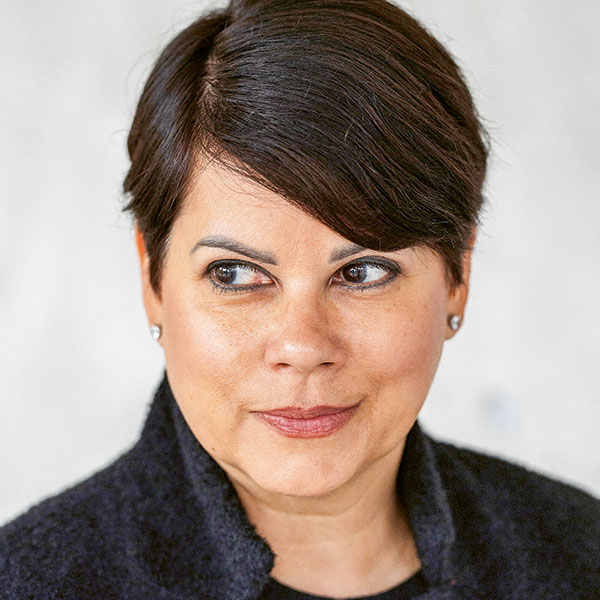
Portrait
An exotic creature in the financial jungle
Stefan Leins is a far cry from the archetypal social anthropologist who travels to distant places to observe exotic rituals. His research field lies practically on his doorstep, where he’s been investigating the financial markets and commodity trading.

Stefan Leins sees himself as a child of the financial crisis and regards financial analysis as a means of creating stories to interpret events on the market. | Photo: Ulrike Meutzner
Some calculations seem pretty straightforward, especially if you’re a young fellow who has to finance his own studies. Back in the early 2000s, Zurich was a financial hub that offered ample jobs for the unqualified – such as computer work or archiving – and at an hourly wage better than anything you’d earn from bartending. Stefan Leins was an anthropology student at the time and needed money, so he sought out the jobs on offer in the finance sector.
He had no idea that his decision would end up having a significant impact on his later career. “I did a few administrative tasks in the back office of an American investment bank, but I wasn’t much interested in what people were doing. And I could never have imagined that it might one day be relevant to my degree studies”.
But then came the financial crisis of 2007. “It was a game-changer”, says Leins. Suddenly, he realised that “something was happening that had immense societal relevance”. Countries teetered on the cusp of bankruptcy, inequality rose, as did unemployment – and all these events exerted an impact on the everyday lives of many people.
It became obvious to him that the real-world repercussions of plummeting share prices could be linked to his field of study. “I’m a child of the financial crisis. All my research interests have developed from this fact”.
No woolly pully
The archetypal anthropologist – according to the cliché – goes off to distant regions of the world to study tribal rituals, beliefs and ethnic peculiarities. But there are also anthropologists conducting research out in the field on Wall Street, in London’s Square Mile and on Paradeplatz in Zurich where all the big Swiss banks sit. The impact of the world’s economic collapse convinced Leins that he wanted to become one of the latter type of anthropologist. But achieving his ambition was no walk in the park. “I contacted a lot of banks to tell them about my research idea, but got only rejections”.
It seems many of them were too nervous about the potential loss of control involved in letting an outsider observe internal procedures and make them public. After all, Leins was adamant that he had to be guaranteed freedom of research: “I couldn’t risk investing two years in my work, then being prevented from publishing anything at the end because the bank vetoed it”, he says.
Moving between different worlds
Stefan Leins was born in 1980 near Zurich. After finishing high school, he initially didn’t feel particularly attracted to tertiary education, so he travelled to Jamaica and spent several months living in a rural area. That experience had a lasting impact on his interest in culture, everyday life and social structures. Afterwards, he did a degree in ethnology, history and Arab studies at the University of Zurich, during which time he also worked part-time at an American investment bank.
He has been a visiting researcher in London, has taught at the universities of Liechtenstein, Lucerne, Trondheim and Zurich, and from 2019 to 2024 he was a junior professor of ethnology at the University of Constance. Today, he’s a professor of social anthropology and the co-director of the Department of Social Anthropology and Cultural Studies at the University of Bern.
But ultimately, it all worked out. Leins spent two years of his doctorate working at a big Swiss bank, though not as an external observer. Instead, he joined its analytical team so that the bank could benefit from his knowledge of Islamic-compliant financial products. For three days every week he wrote reports, attended meetings and compiled market analyses. On the remaining days, he worked on his doctoral thesis. At the same time, however, he engaged in ethnographic observations of the everyday life of financial analysts. He wanted to see how they developed forecasts and how they discussed things, expressed doubts and speculated amongst themselves.
He had an advantage in all this: “I knew the cultural codes”. He was aware that the others would frown upon him if he wore only a worn-out woolly pullover and faded jeans. And he knew the vernacular and manners of his work colleagues. But he remained something of an exotic outsider all the same. His background was quite different from theirs, and his politics tended to the left. So in the days leading up to the workers’ holiday of 1 May, he had to put up with comments from his colleagues such as: “We don’t want to see a picture of you in the paper, marching with the commies”.
The virtues of astrology
Leins’s two years of field research resulted in a doctoral thesis that he later turned into a book entitled ‘Stories of Capitalism’. In it, he focuses on the circumstances in which financial actors operate. Contrary to common preconceptions, he found that the people working in banks are not amoral, and in fact many of them struggle with what they do. But at the same time, they’re manoeuvring within a system that itself prompts them to take specific decisions and barely allows any others. “Capitalism moulds people so that they function according to an economic system”, says Leins. And this logic sometimes stands in contradiction to people’s own ethical intuition.
That was all a good 18 years ago. Today, Leins is a professor and co-director of the Department of Social Anthropology and Cultural Studies at the University of Bern. He has explained to us why his field of research isn’t as absurd as it can seem to outsiders. What really matters from an anthropological perspective, he says, is not where you are, but how people act; how they justify their decisions, and the stories they tell themselves about what they do.
In his doctoral thesis, he pondered questions such as: Why do highly paid analysts sit in front of their computer screens day in, day out, even though they’re ultimately no better at predicting the market than someone making a random forecast? Leins’s answer to this sounds in itself paradoxical: “These analysts exist, not because the market is predictable, but precisely because it’s not”. Their task is less about predicting what will happen than about interpreting it. They’re there to tell stories that will create order – something we often refer to as a narrative.
But this isn’t necessarily the image of themselves that the banks would like to present to the outside world. When financial experts explain their prognoses, they talk about models and calculations. But if you monitor them as closely as Leins did, you can perceive further dimensions in what they do. “Sometimes they even use astrology as an argument”, he says – things that would never get mentioned in expert interviews.
Questioning the self-evident
But this raises the question as to whether this type of field research can ever produce any conclusions that go beyond mere subjective assessment. Leins admits that this is a valid objection. “I’m my own research instrument. My own position in this does not disappear”. When he’s in the field, the fact that he’s male, a Swiss citizen and an academic all influences what he sees and what people tell him. The technical term for this is ‘positionality’. “My observations are culturally determined. And our results are thus also our own interpretations”.
So his strategy is to be open about his own perspective. He doesn’t even try to hide it. Transparency replaces any claims to objectivity. Qualitative field research with so-called participant observation doesn’t provide quick answers or quick solutions. But it can bring to the surface things that might otherwise be easily overlooked – such as how economic logic seeps into everyday life, and how people adapt to systems that they haven’t themselves created.
But Leins does more than just observe. He also produces reports and expert assessments – such as on commodity trading and supply chains – and the opinions he puts on paper flow into political processes. He’s less concerned about providing ready-made solutions than with offering new perspectives. “We can prove that many things that people assume to be natural and inevitable are in fact man-made”, he says. “Much of what we take for granted could also be different”.
This attitude of his is also reflected in a current research project that he and his team are working on. They’re investigating areas where speculation takes place, such as cryptocurrencies, setting up ‘sustainable’ financial products, or flexible employment relationships in the catering industry. What interests them is how those who are affected cope with an uncertain future.
Making uncertainties visible
Given the situation in the world today, this is surely a topic that concerns a lot of people. Here as before, Leins and his colleagues will hardly be providing anyone with simple answers. But his motivation lies precisely in making uncertainties visible and comprehensible. “I’m passionate about what I do. I think it’s both meaningful and relevant”. For him, this also includes promoting a sense of collaboration within his department. “I’m responsible for the people who work with me”, he says.
It’s important simply to be there and to demonstrate sincerity when you deal with one another. “Both these things are highly underestimated in an academic context”. He’s familiar with such problems from his own experiences as a mid-level academic. So he’s consciously trying not to repeat the mistakes he’s observed in others. This means, not least, acknowledging the achievements of his colleagues and communicating them to the outside. “I don’t want to become that old man whose name has to be on everything”, he says. “I have doctoral students and postdocs who are much smarter than me”.