An equitable formula for placing children in schools
The Zurich-based company Ville Juste aims to ensure more equitable educational opportunities for all children, regardless of whether they live in a block of flats or a villa in an upmarket residential suburb. To this end, they take data from municipal authorities and enter it into a tool they’ve created. This then matches children with appropriate kindergartens, schools and individual school classes.
For more information, move your mouse over the numbers or tap on them.
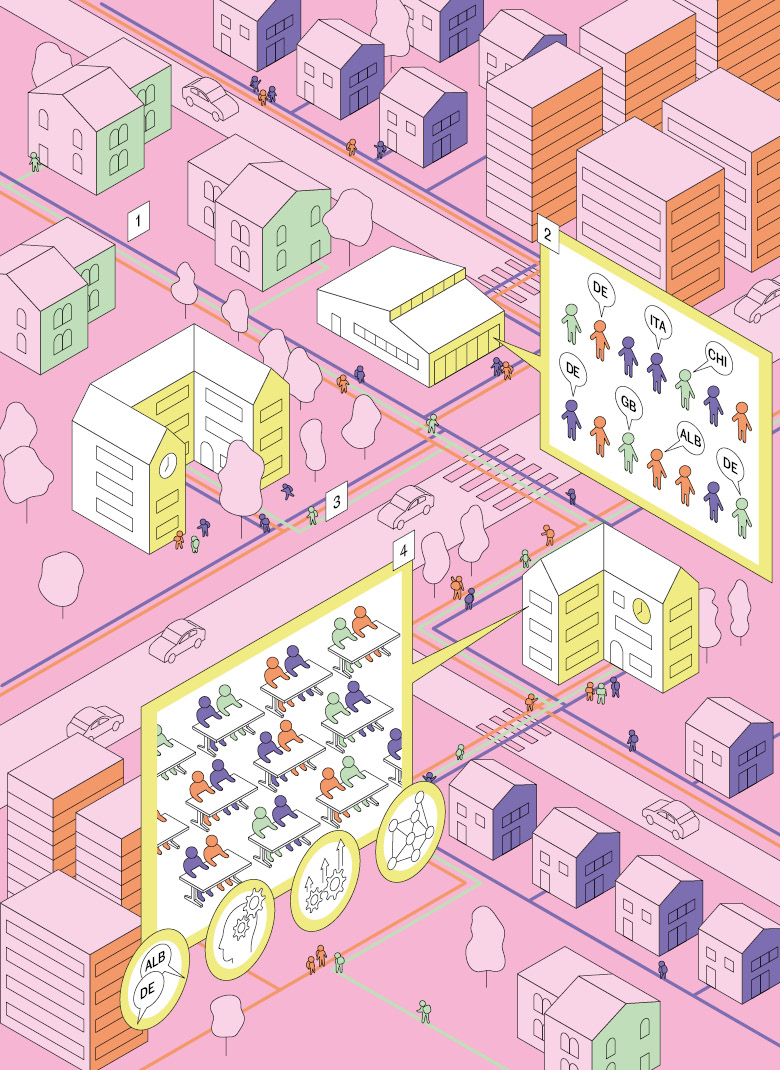
Illustration: Ikonaut
4 — Creating a fair allocation
This data is then combined so that an algorithm can calculate the most balanced allocation formula possible for each school. This algorithm is rule-based, which means that all its criteria are defined within the tool and can be explained transparently. What’s more, the tool also takes information provided by teachers into account, e.g., children’s grades, their competencies, necessary support measures, gender and the relationships among children. This enables the tool to determine an equitable allocation of pupils to classes within a schoolhouse.
3 — Optimising school routes
Different routes lead from each neighbourhood to the primary and secondary schools. The tool calculates the shortest and safest route in each case. The maximum distance that a child may be required to walk to school is specified by the local authorities.
2 — Registering language skills
The tool also analyses the information provided by schools regarding the first language of its children and their German-language skills – as shown here, from a kindergarten.
1 — Categorising streets by income
Many communities feature informal geographical segregation between affluent and lower-income families. This in turn results in segregated schools. Achieving greater equality of distribution is complicated, but very important, because Swiss data from longitudinal studies and surveys by PISA (the OECD’s Programme for International Student Assessment) have shown that both the school and the class that a child attends can influence their educational success and career path, regardless of individual social disadvantages like poverty. The Zurich-based start-up Ville Juste wants to tackle this problem in collaboration with municipal authorities. They have developed a tool that uses anonymised tax data to classify streets according to their relative poverty rate. Households are categorised as poor when they have a disposable income of less than 60 percent of the median income. At present, this tool is being used by the local authority in Uster, a town in the canton of Zurich.