Vines learn to fight with fungi
At the Changins College of Viticulture and Oenology in the canton of Vaud, researchers are trying to reduce the use of synthetic fungicides in wine-making. We walk through the vineyard and its laboratory.

The experimental vineyard of the Changins College of Viticulture and Oenology in Nyon is growing fungus-resistant grapes. | Photo: Sébastien Agnetti
Markus Rienth gently turns a vine leaf over and shows me a spot slightly lighter coloured than the rest of its green surface. Behind him the vines descend in tight rows towards Lake Geneva, like soldiers on parade. He’s the head of the wine-making department of the Changins College of Viticulture and Oenology in the canton of Vaud, and he says, “this discolouration is caused by mildew. Obviously, this grape variety is not resistant enough”.
“Later, when we’re in the lab, I’ll show you some more marked examples of mildew attack”, he says. For the moment, he leads us even deeper into the experimental vineyard, as he shows us around this part of the institution. This area is about half a hectare and has in recent years been devoted to a project to develop the growth of grape varieties resistant to diseases caused by fungi.
From winemaker’s son to wine-making professor
Rienth has one foot on the terrain and the other in the laboratory, personifying the concept of applied research that dominates here in Changins. When you walk on the steep site perched just above Nyon, you gain the impression that one nostril is tickled by the aromas of grapes maturing, while the other captures the smell of the chemicals used to clean test tubes. He’s the son of a winemaker and earned his PhD in wine making, so he’s as comfortable here as a fish in water.
Rienth grew up in Baden-Württemberg in Germany. After his master’s degree, a doctoral thesis and a postdoc at the Institut Agro Montpellier, he came to Changins in 2015 as a professor. “Our winemaking centre focuses its research along two lines”, he says. The first is the impact of climate change on the physiology of the vine, and the other concerns reducing the use of both synthetic and organic fungicides.
In this second area, several projects are being carried out in parallel. They focus on the one hand on replacing artificial fungicides by natural substances and on the other hand on increasing the resistance of the vine to so-called cryptogamic diseases caused by fungi and pseudo-fungi, especially mildew. “We should also talk about tolerance rather than resistance”, he says. “It is indeed illusory to hope to achieve complete resistance”.
As part of the Innopiwi project (from the German ‘Piwi’, for pilzwiederstandsfähige Sorten, or ‘fungus-resistant varieties’), 40 new grape varieties – created by various private or public research institutes throughout Europe – were chosen and planted where we stand today. These are multi-resistant grape varieties possessing several genes of resistance against mildew and powdery mildew. The purpose of this research, funded by the Swiss Federal Office for Agriculture (FOAG), is to evaluate the agronomic, oenological and resistance potential of these grape varieties.

The Changins College of Viticulture and Oenology above Nyon is cultivating disease-resistant vines. The grapevine louse has its home in the growths on these leaves. | Photos: Sébastien Agnetti
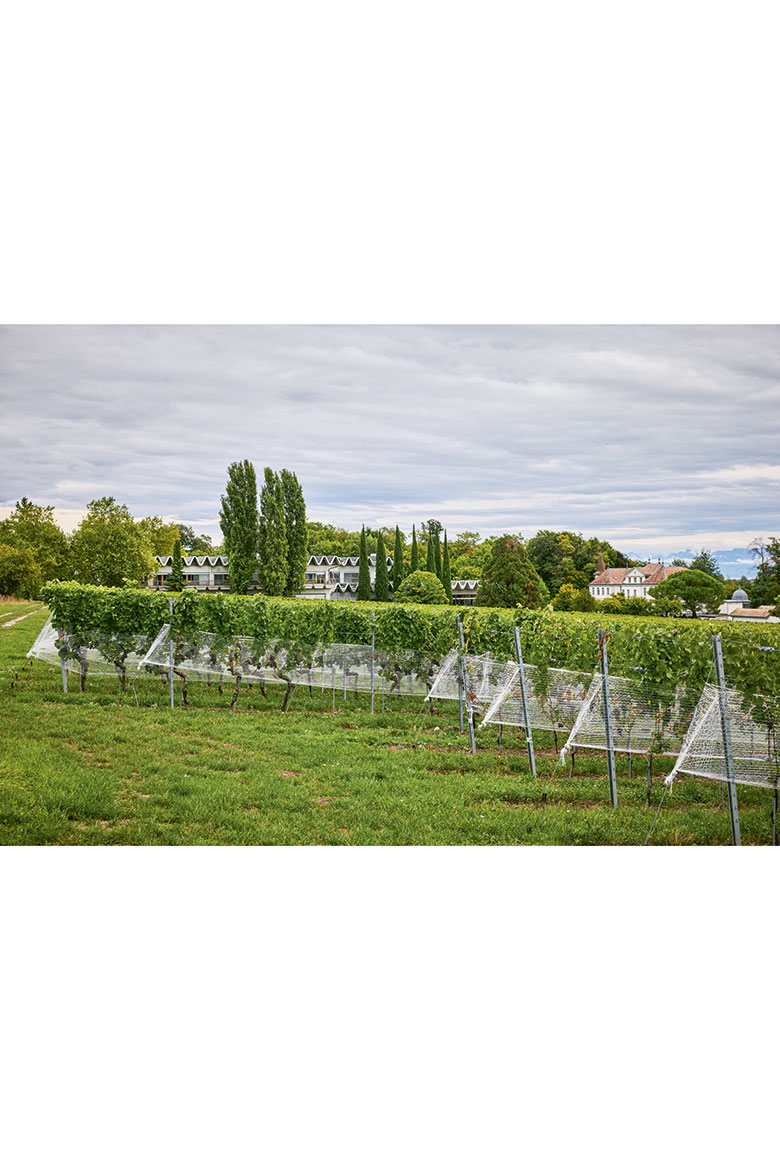
In this experimental vineyard above Lake Geneva, different grape varieties are being tested for their resistance to funguses including downy mildew.
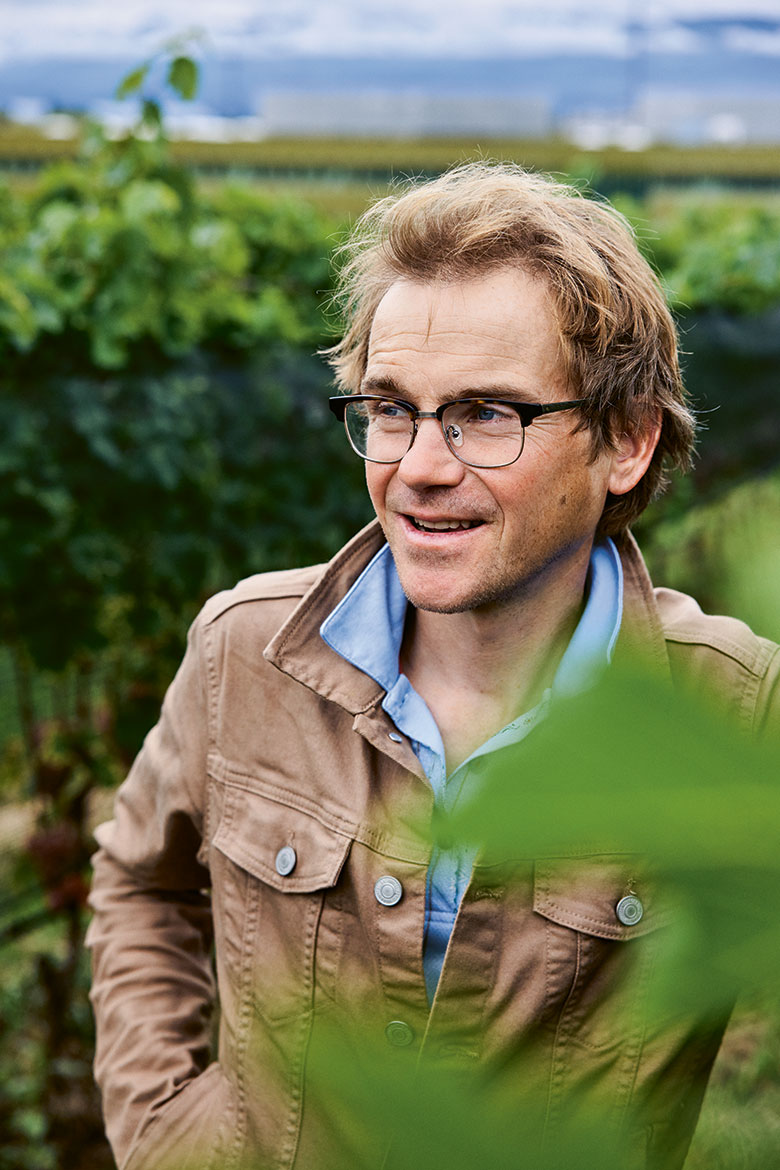
Markus Rienth is a professor and Head of the Department of Viticulture at Changins.
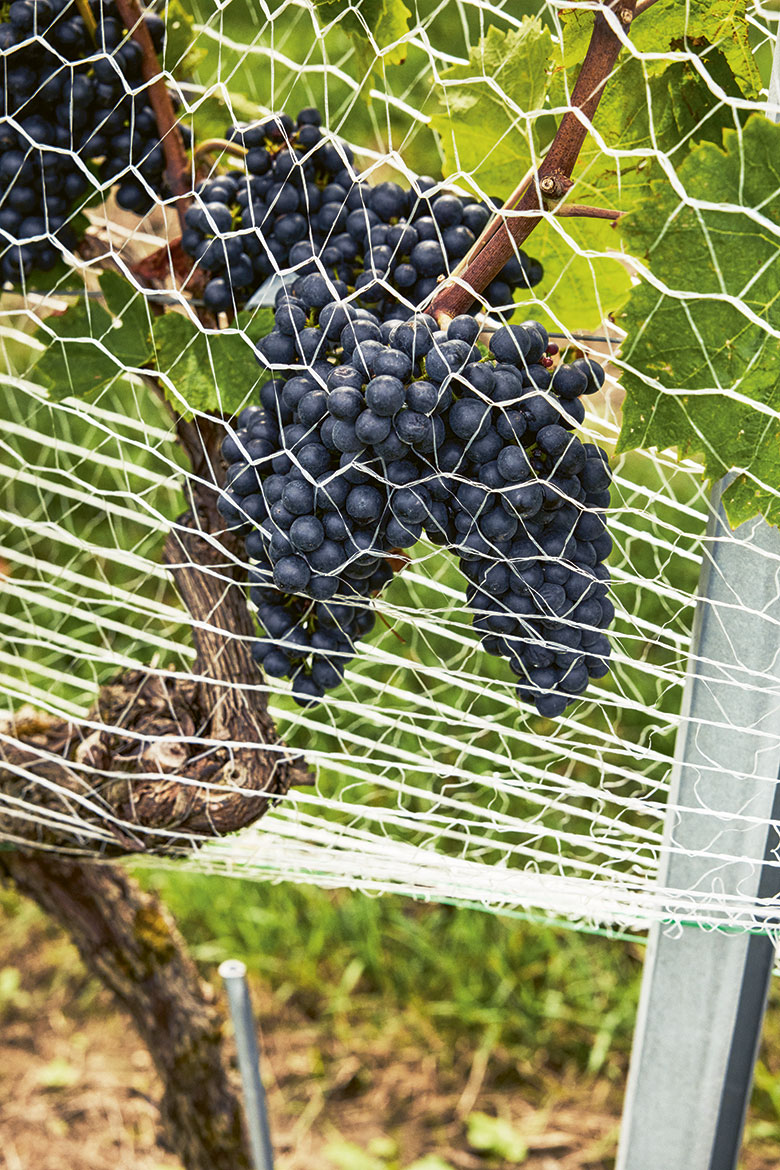
A fungus-resistant variety of red grape.
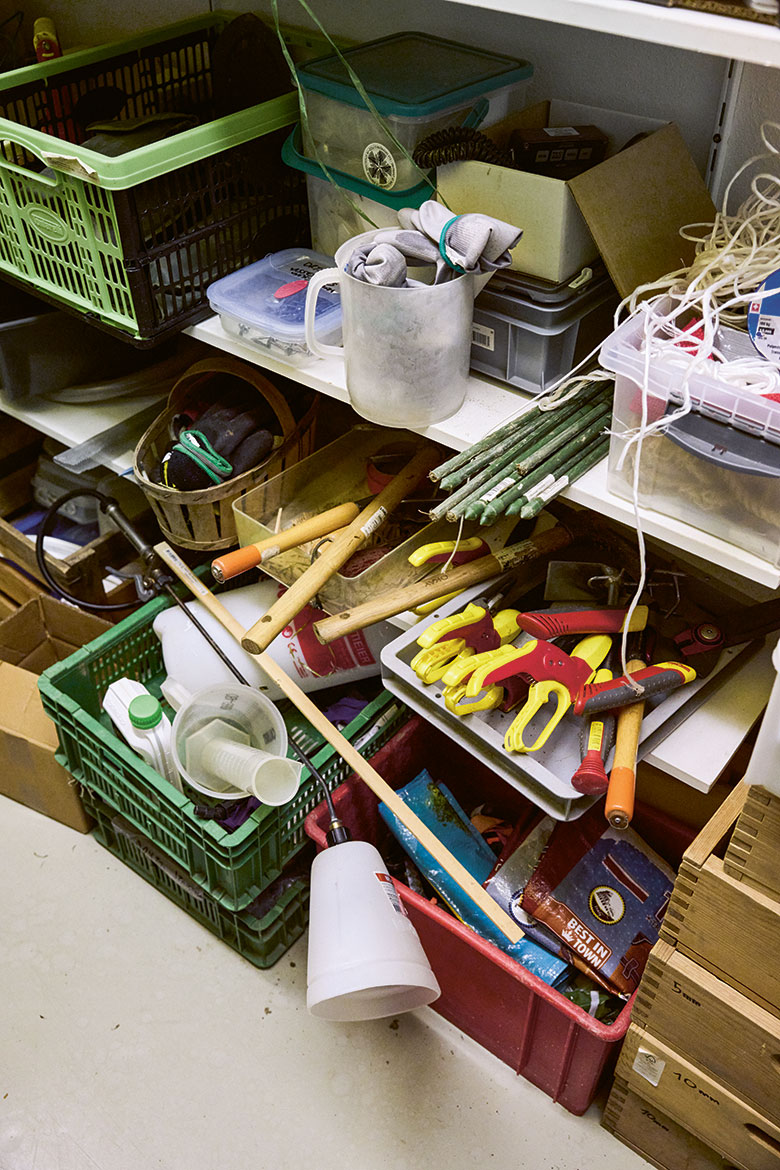
Various utensils for student fieldwork out in the soil of Changins.
In particular, researchers are systematically studying their performance, physiology, resistance to abiotic stress (caused for example by heat, frost or drought), their resistance to pathogens and their organoleptic qualities (appearance, smell, taste, etc.). All of this is intended to culminate in concrete recommendations for winegrowers who would like to cultivate Piwi grape varieties adapted to Switzerland. It should be noted that as part of the same project, identical studies are being carried out on two other Swiss research sites with different soil and climatic conditions, in Frick in the canton of Aargau and Wädenswil in the canton of Zurich.
To the untrained eye, the different varieties planted here – a few minutes’ walk from the college buildings – are distinguished from each other only by the colour of their bunches of grapes, varying between dark blue and amber yellow. Nowhere are there panels indicating their names or origins of the immaculately groomed vines. Only a simple number allows the research team to identify them. “This is aimed at preventing theft,” says Rienth with a wink.
A slow and complex process
While the Innopiwi project continues, its Oenopiwi extension, also funded by FOAG and focused on winemaking trials, is due to start in 2026. Fully understanding the context of these projects requires a brief retrospective.
According to Rienth, “for a long time, the European vine, Vitis vinifera, was not exposed to fungal diseases. That’s why it never developed any natural resistance”. At the end of the 19th century, with the growth in trade, however, the well-known diseases of the Americas reached European soils.

Researchers use this device to measure the photosynthesis activity of a leaf out in the field. | Photos: Sébastien Agnetti
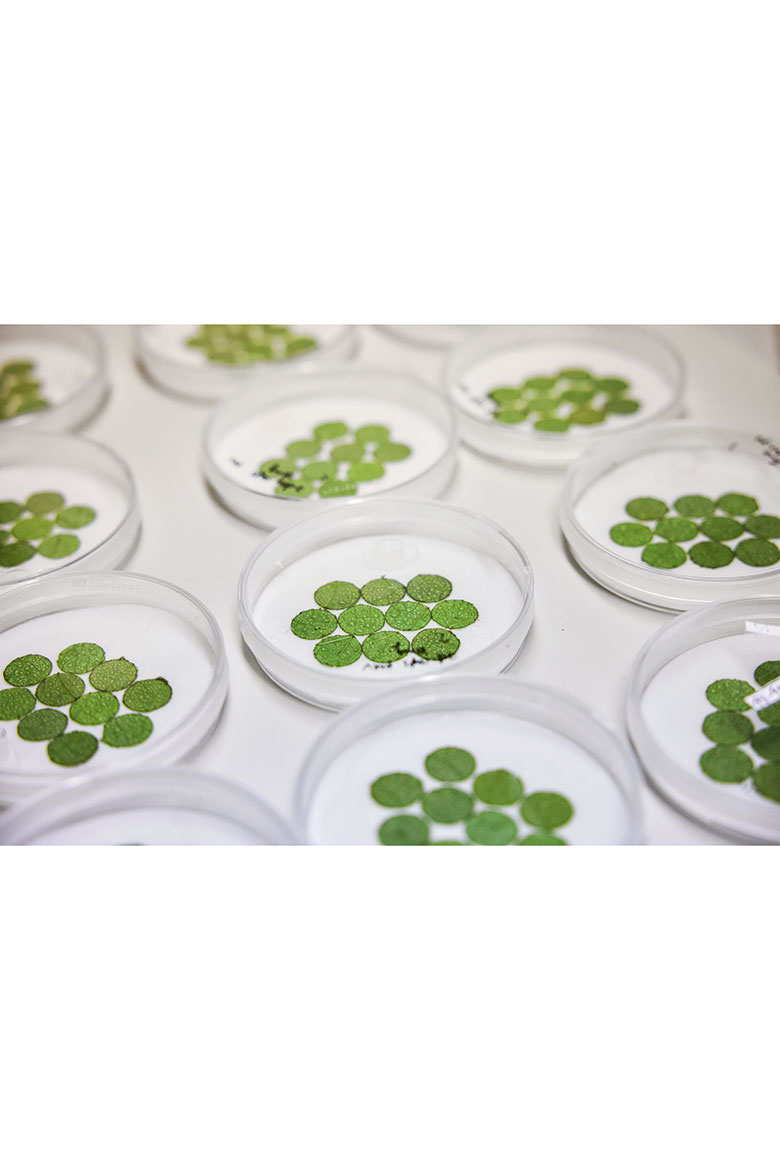
These discs cut out of vine leaves are infected with downy mildew. This lets the researchers compare the fungus-resistant qualities of the different vines.
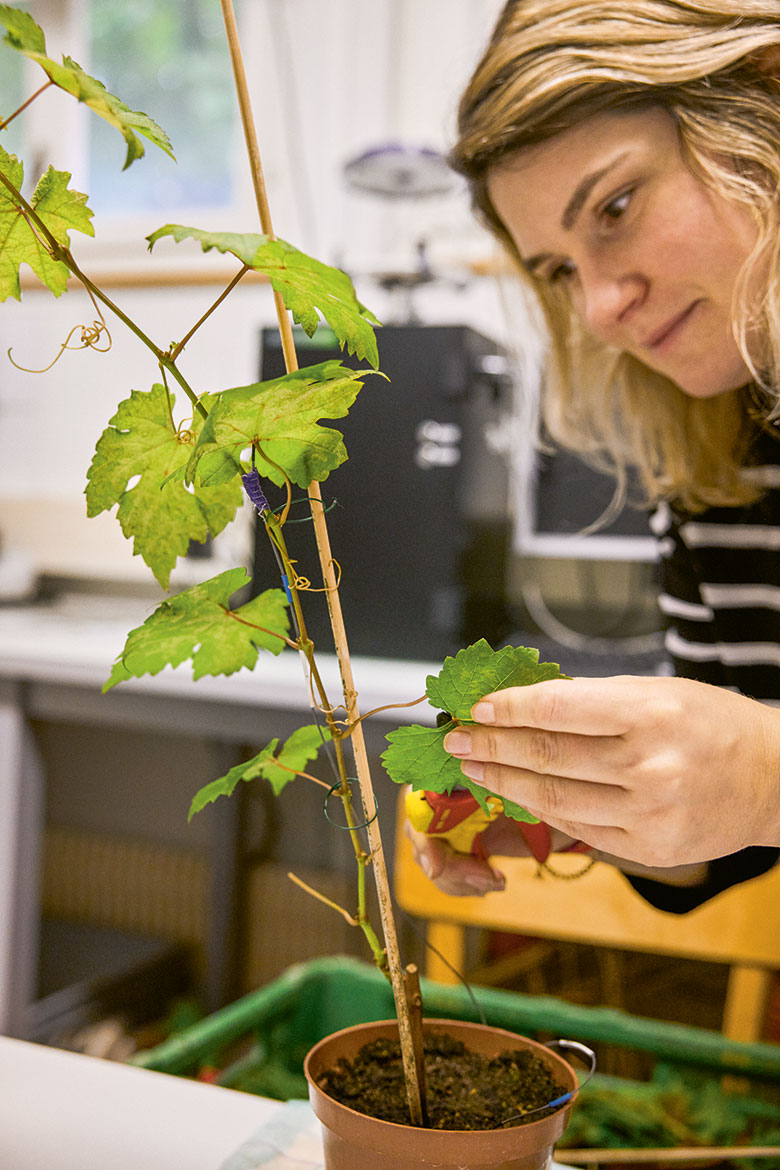
Amanda Malvessi-Cattani is a postdoc. Here, she’s assessing just how infected the vine is.

Soil samples ready for analysis.

Malvessi-Cattani takes photos of the leaves for a subsequent image analysis of their downy mildew infestation.
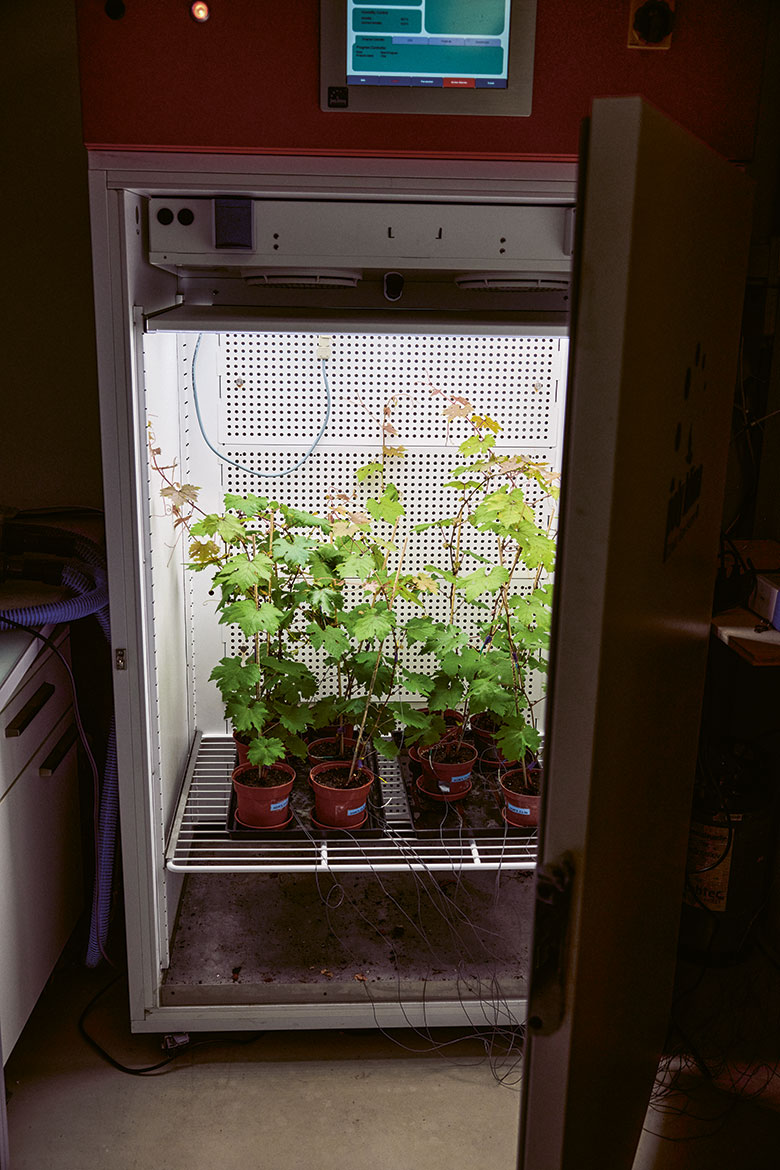
The conditions in this climate chamber are carefully controlled.
To deal with this, agronomy first used copper and sulphur, before turning massively to synthetic fungicides as of the 1930s. “By the middle of the 20th century, we began to become aware of the problems related to these fungicides and looked at – among other things – cross-breeding with American vines”. Unlike their European cousins, they are naturally resistant to cryptogamic diseases. Over time, and with successive cross-breeding, we’ve managed to create grape varieties of interest in terms of their resistance and their taste profiles.
“But this is a process that is both complex and slow, given that it takes about 15 years to develop a series of cross-breeds if we don’t use genetically modified organisms (GMOs)”. Admittedly, modern technologies such as molecular marker-assisted selection have allowed a slight acceleration of the cycle. “But the only way to make leaps forward would be the authorisation of GMOs”, Rienth says, before adding, “please note that I’m not saying that I’m personally in favour of lifting the moratorium”.
A matter of certain essential oils
As it stands, the greatest challenge faced by researchers is that of oenological quality. “A lot of resistant white grape varieties have the right taste profiles”, he says. “But when it comes to reds, it’s more complicated”. That’s why in parallel with the work aimed at creating more resistant grape varieties, they are also looking at other means of reducing the use of synthetic and organic fungicides to ensure the viability of wine ecosystems. And to meet the expectations of consumers increasingly concerned about their environmental impact.
“Some essential oils are promising, either for their ability to stimulate the self-defence mechanisms of the vine or for their inherent anti-fungal properties”. As part of a study funded by the SNSF, Rienth’s team has already managed to demonstrate the potential of oregano to trigger the immune system reaction of the vine. Working with chemists, they began a new research project in the summer of 2025 called Biocapvine. It aims to micro-encapsulate oregano essential oils in alginate and chitosan. A process that “prevents the leaching and degradation of oils, while reducing their phytotoxicity and expanding the release of volatile substances”. This way, the natural defences of the plant are stimulated longer against mildew.
Consumer crisis
We’ve been lucky with the weather until now, and seeing the threat of rain, Rienth suggests we take refuge in one of the laboratories used by his team. Inside, a researcher is taking out potted vine plants from a refrigerator, the leaves of which have characteristic spots of mildew. Further inside, Rienth shows me a series of Petri dishes on a table, in which three-lobed leaves sit alongside what look like small marbles. “These are the microcapsules containing essential oils”.
For the remainder of the interview, we stay indoors in this room with its clinical lighting and the rain lashing the windows. Our time together draws to an end by looking at a point of view of society. “Beyond the problems posed by climate change and fungal diseases, wine-making is facing a huge challenge because global wine consumption is dropping”.
When it comes to public health, this development can certainly be described as encouraging, he says. But for producers, it is a matter of adapting in such a way as to stand a chance against the competition. “In terms of marketing, Swiss wines still have a great potential for improvement. While their quality is excellent, they represent only less than half of our national consumption”.