
A microphone for wild animals
“Animals talk; we translate”. An EPFL spin-off is developing an audio sensor and software to assess and monitor biodiversity.
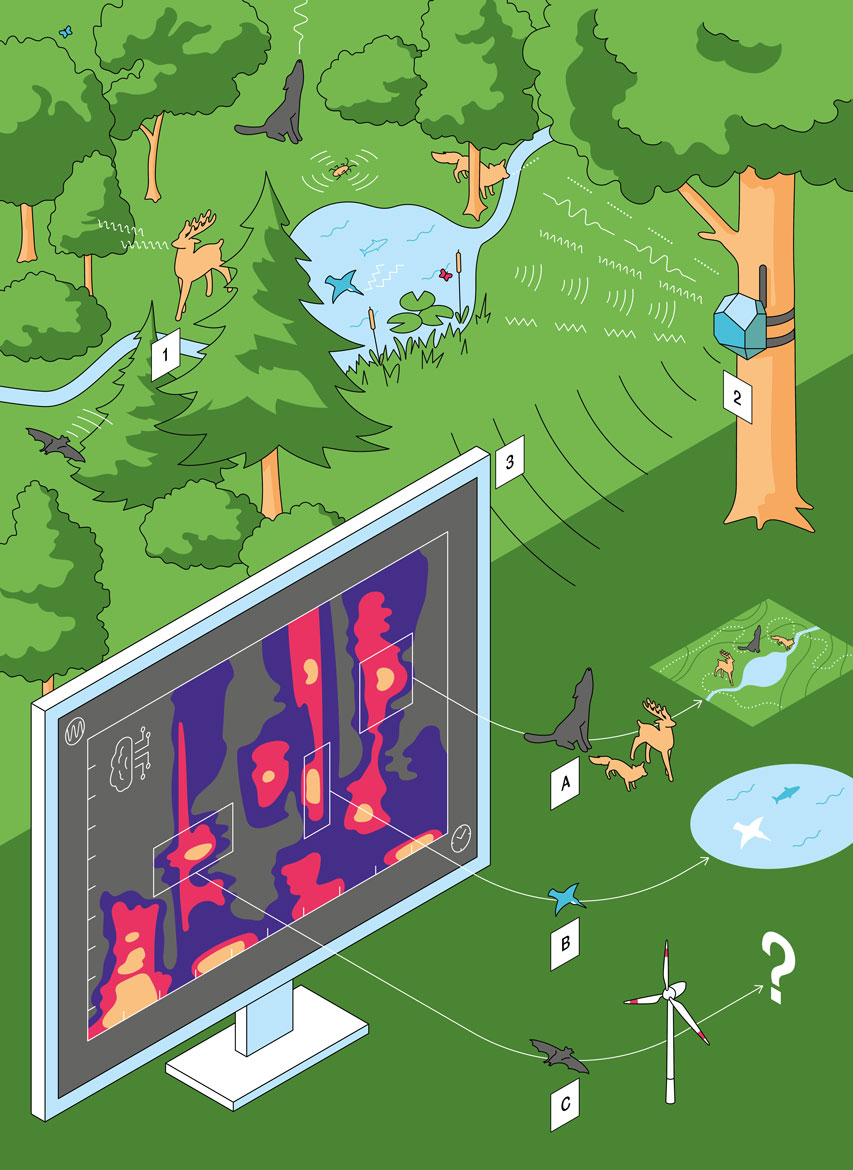
Illustration: Ikonaut
3 — AI deciphers sounds
The software transforms the soundtrack into a spectrogram, a graphical representation that indicates which frequencies are captured over time. These images are fed through an artificial intelligence algorithm, which detects the patterns in the sounds made by animals. We can then identify the species passing through the study area (A). Alternatively – thanks to additional databases – we can draw conclusions about silent aspects: the detection of a kingfisher indicates, for example, the presence of fresh water and certain species of fish (B). The technology is also used to plan or evaluate the impact of installations, e.g., solar or wind power plants, according to the animals identified before or after construction (C). The start-up is now refining its algorithm to be able to understand animals in addition to identifying them - by distinguishing, for example, warning, hunting or mating calls.
2 — A self-contained and robust housing
The sensor has four microphones, to filter background noise and to detect the direction of sounds. It is fitted with a secure battery, which lasts more than 900 hours and connects to a solar panel, and a 4G transmitter, which automatically and permanently sends data to the cloud. All this is embedded in a housing designed to withstand frost, rain and falling branches.
1 — No way to observe around the clock
To observe the wildlife of our forests or mountains, we would need experts on the lookout day and night, in all weathers. In addition to the practical challenges, humans would also disturb animals. The EPFL start-up Synature bases its work on studying ecosystems using animal noises. It is developing a system capable of locating several thousand different species, as far away as about three kilometres for the most vocal, such as wolves.