At the crime scene
Forensic science laboratories make fingerprints visible using metal powder, superglue and lasers. We investigate why fingerprints still play a key role in forensics today, and consider the limits of using old-fashioned methods.
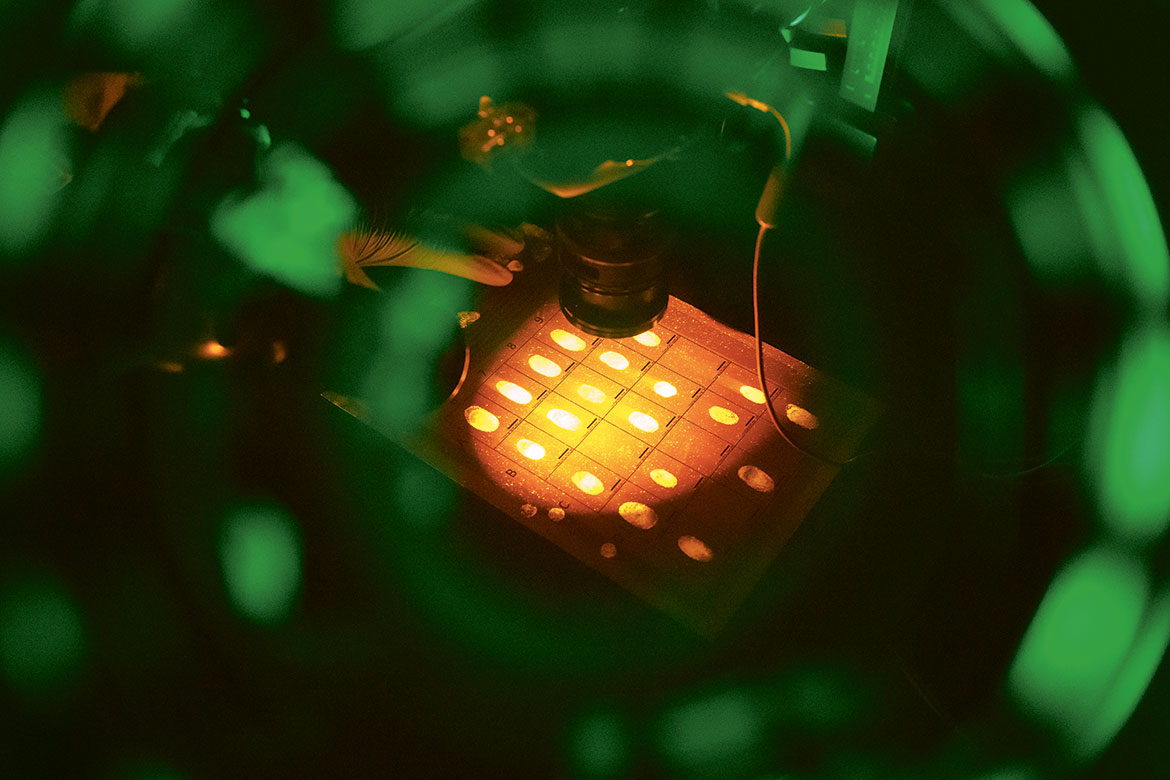
Fingerprints are detected here in the darkroom of the forensic science lab of the University of Lausanne. | Photo: Pierre-Yves Massot
It’s almost like an episode of CSI. A forensic scientist wearing blue gloves and a white lab coat is carefully dusting a pane of glass with a soft brush. As if out of nowhere, a shiny grey streak appears: it’s a fingerprint. “It’s really easy. Give it a try!”, says Andy Bécue as he hands over his brush. He’s a chemist and a professor in the forensic science lab at the University of Lausanne.
The procedure in fact soon proves to be pretty tricky for someone with no experience. What looks like a paintbrush turns out to be a magnetic rod with thousands of miniscule metal particles stuck to it. Press too hard and a glittering torrent is disgorged over the surface of the glass. “No worries”, says Bécue, laughing. “You can load it up with new filings”. He demonstrates this by dipping the rod back into a container full of these glittering, crumb-like particles.
This so-called dusting method was developed in around 1900 and it’s still the routine method in use today when you want to reveal fingerprints on smooth surfaces. “We carry out dusting mostly at the crime scene itself”, says Bécue, “when we’re dealing with objects we can’t take back to the lab with us – such as windows, furniture or other large surfaces”.
Bécue has been teaching and researching at Lausanne since 2004. His specialist field is techniques for detecting forensic traces. Fingerprints remain a core aspect of criminalistics, despite the rise of DNA analysis. While he’s busy using a magnetic rod to collect the last metal filings from the table in front of us, he explains why: “A fingerprint establishes a direct link to a person and indicates that they’ve touched an object. DNA can also make such a connection, though it can also end up in a place by sheer chance. It’s important to combine both types of evidence”.
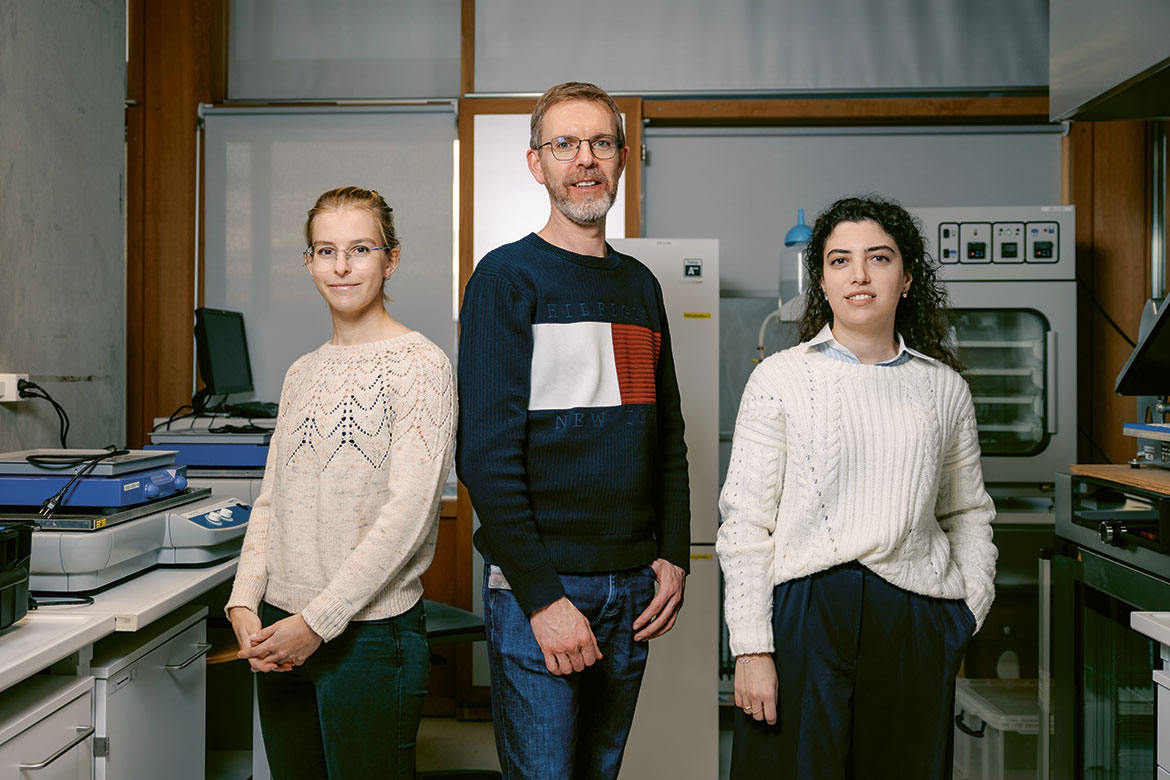
Bérénice Bonnaz (doctoral student), Andy Bécue (head of the forensic science lab) and Talita Haddad (doctoral student), all based at the University of Lausanne, are investigating how forensic detection techniques can be made more comparable and environmentally friendly. | Photos: Pierre-Yves Massot

A magnetic rod with metal filings can make fingerprints visible on surfaces. This so-called dusting method has been in use since 1900.
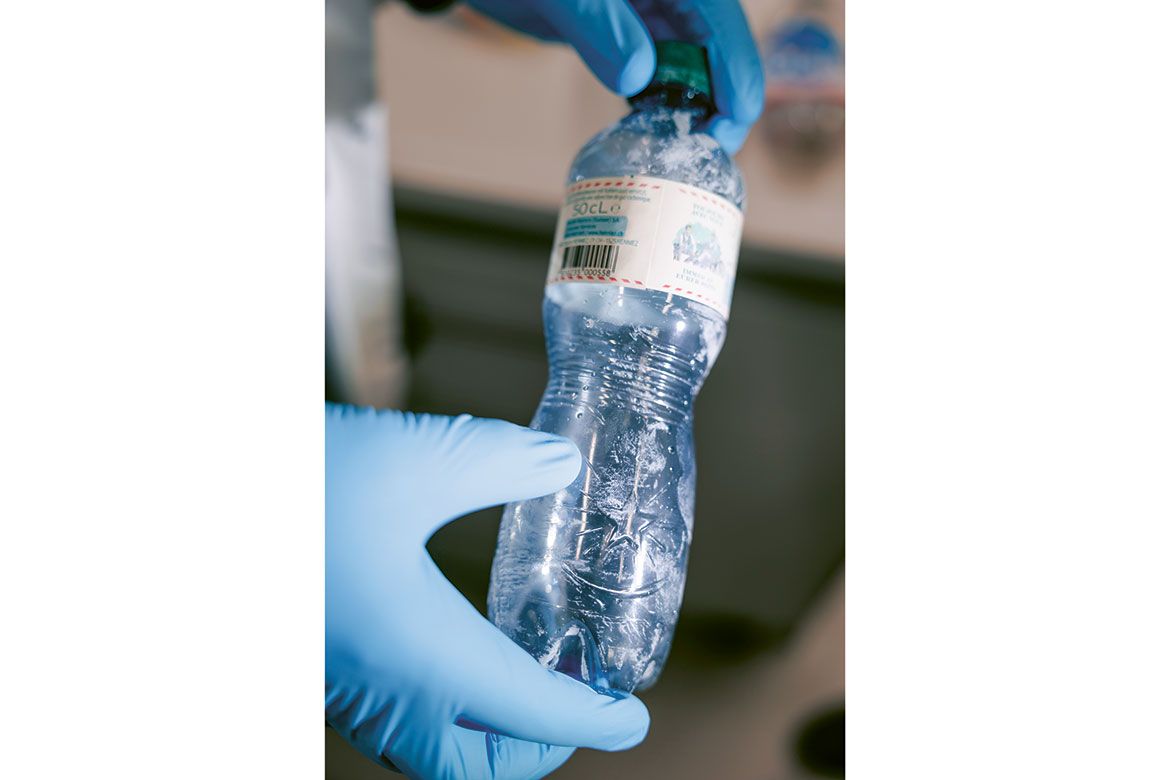
The vapour of superglue can reveal fingerprints on PET bottles.
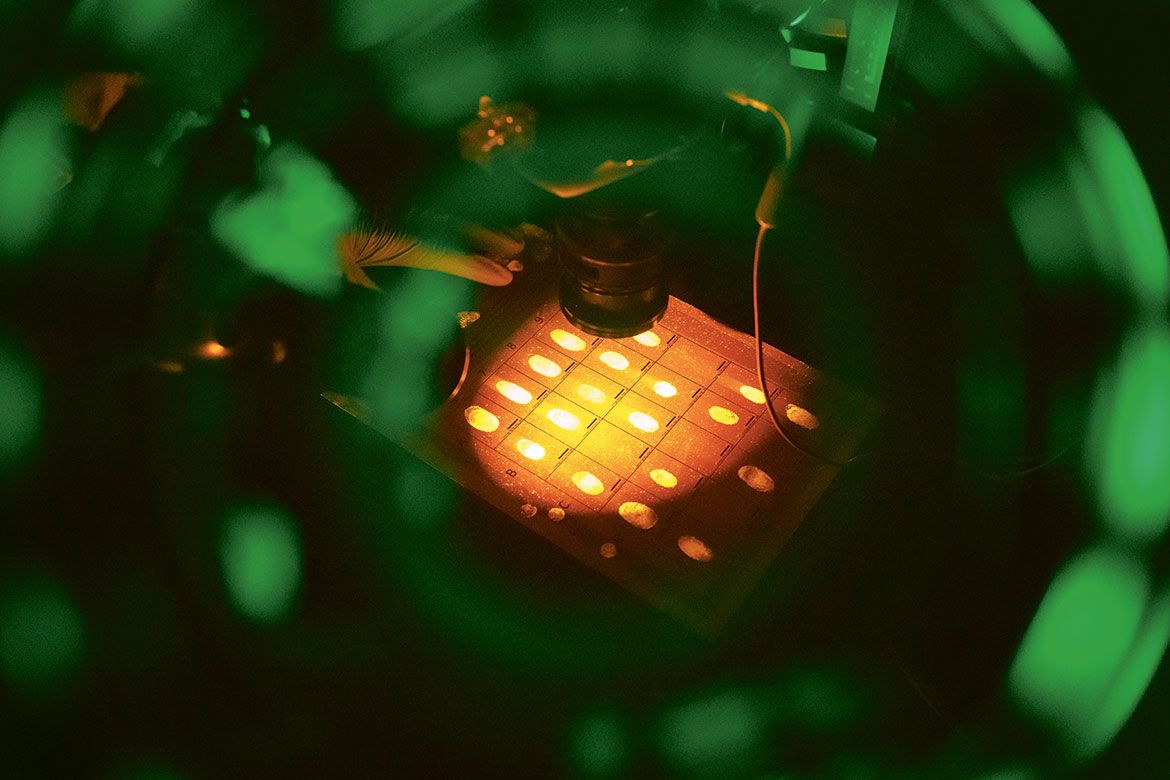
Bright orange fingerprints glow on this sheet of paper in the darkroom of the lab. It had first been dipped in the fluorescent indicator indandione.
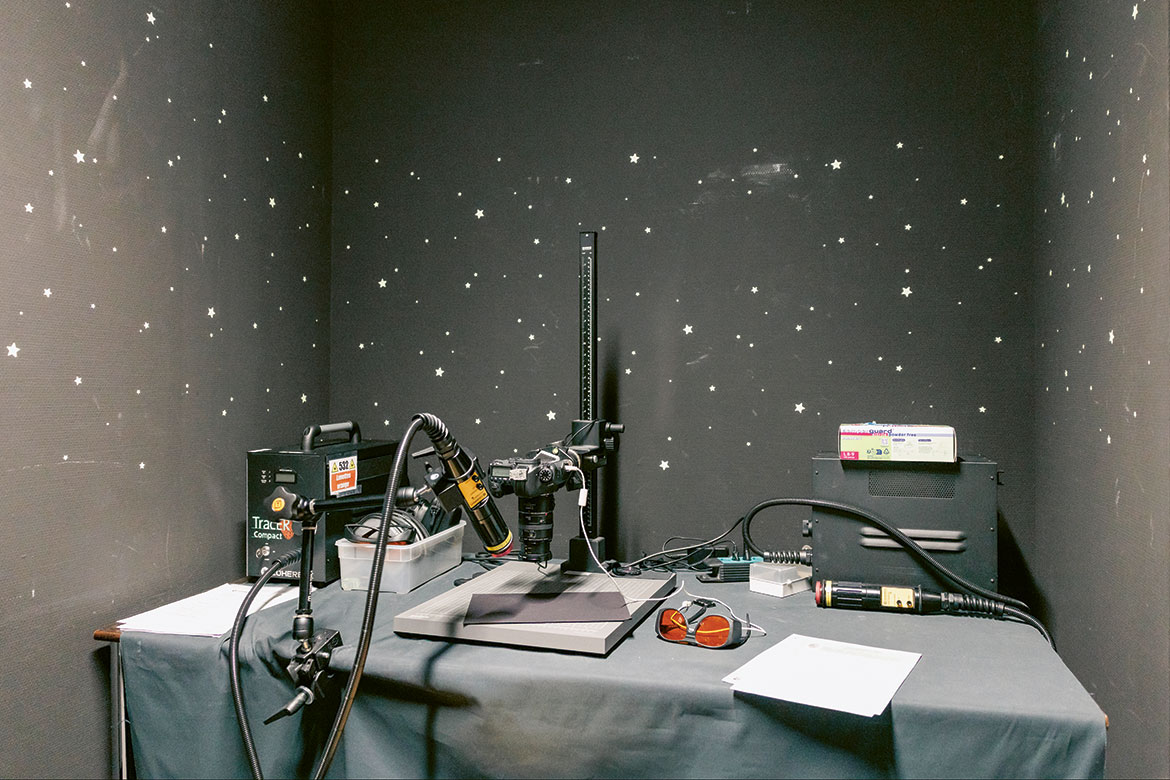
Hundreds of glow-in-the-dark stickers adorn the walls of the darkroom. They have no research function, but help to brighten up long working days in the darkness.
What’s surprising is that many of the techniques and chemicals used to reveal fingerprints on different surfaces have remained virtually unchanged for many years. “This isn’t because we’re unable to think of anything better”, says Bécue, “but because the old techniques are still good”. There’s indeed a blind spot in this particular branch of science, but it lies elsewhere: “With some methods, we just don’t know exactly how they work and where their limits lie. Nor do we know what to do if they suddenly don’t work as well as before”. And this is precisely where the research comes in that he’s doing in his lab. His task is to make detection techniques measurable, more environmentally friendly, and verifiable.
Working with photos
Next to his glass-bottomed desk, a smartphone is hanging above a flat metal box with a rose motif that’s covered in shimmering silver fingerprints. “Every one of these prints has to be documented” says Bérénice Bonnaz, a doctoral student. “That means we photograph them – the image quality is just as important as the detection process”. Photos provide the basis for all the further steps to be undertaken: comparison, identification, and a reconstruction of the course of events. Bonnaz calls this “following the trail of a clue”.
The setup here belongs to the doctoral project of Arthur Baert, who is investigating whether smartphones meet the necessary quality criteria for this type of photo. He wants to find out if police officers could photograph evidence with their mobile phone at the actual crime scene instead of with the usual single-lens reflex cameras. Baert is currently out of the office, so Bonnaz explains his project to us. She turns the phone millimetre by millimetre until its lens is exactly parallel to the surface. Then she explains the problems involved: “Mobile phone cameras can distort images significantly. Even the slightest tilt can alter an image – and thus reduce its validity”.
Bonnaz herself is working on evaluating the quality of fingerprint remnants. “Traditionally, scientists would use analogue means to assess them”, she says. Using criteria such as the contrast and definition of the so-called papillary lines, they would examine thousands of images and ultimately assign a score.
Despite clear guidelines, there is still a great deal of subjectivity involved. So in her doctoral thesis, Bonnaz tested two algorithms that could perform this evaluation automatically. “The results are more objective – and, above all, more reproducible”, she says. If you’re researching different detection methods, it’s essential to standardise quality measurements. “We have to define what we’re measuring, and how”, says Bécue. “That’s the only way to find out whether one method functions better than another”.
The foggy, foggy glue
At the beginning of our meeting, Bécue had rummaged around in a recycling bin in the cafeteria from which he extracted three empty PET bottles. He now places them in a square glass box. “There’s bound to be lots of prints on them”, he says. This particular box is a fuming chamber that forensic scientists call a cyanoacrylate cabinet.
Cyanoacrylate is the substance better known to us as superglue, and it’s vapourised in the cabinet. When subjected to high humidity, it reacts with substances from human sweat and the fatty matter secreted by the sebaceous glands in our skin that adhere to plastic. After a few minutes, white structures gradually emerge and take shape on the bottles. The superglue is used for non-porous materials, alongside dusting for fingerprints – though as a rule it’s used on objects that can be transported to the lab.

The forensic science lab also creates reproducible ‘bloody’ fingerprints using stamps. | Photos: Pierre-Yves Massot

This is because it’s almost impossible to make a series of fingerprints with real fingers that all have the same quality and composition.
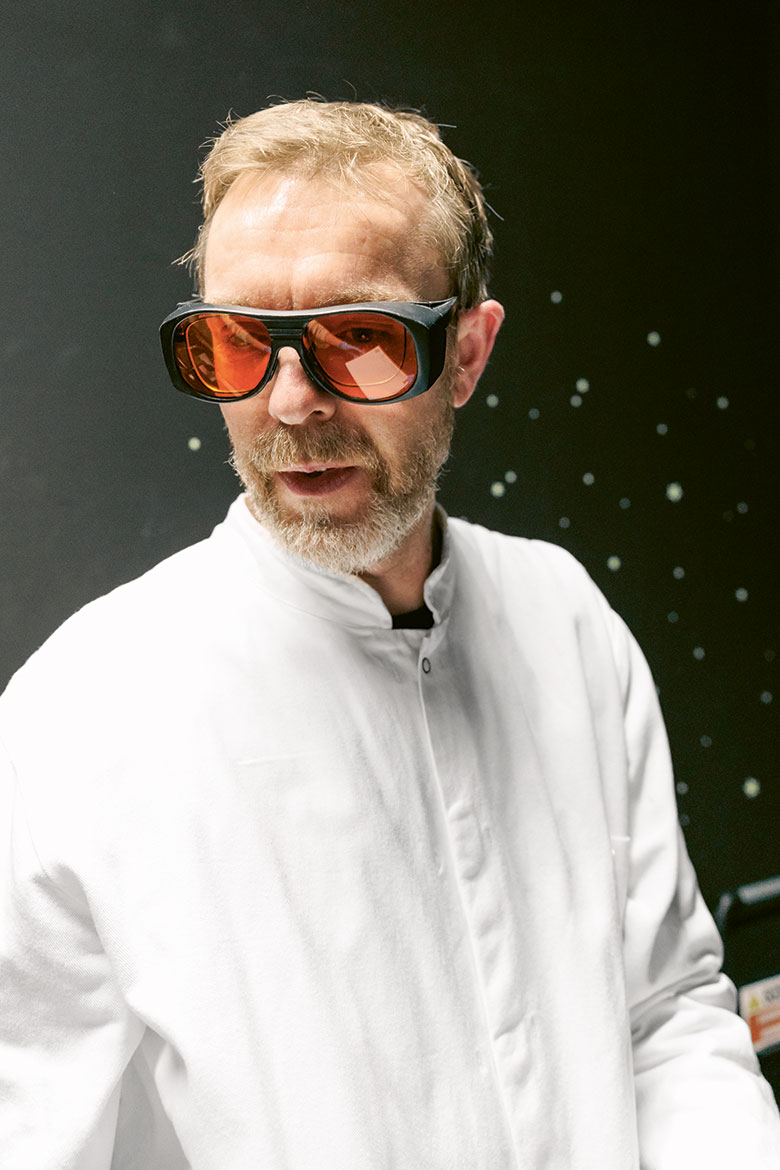
Andy Bécue, the chemist who runs the lab, is always hunting for fingerprints.
After a surface has been dipped in the reagent mixture...
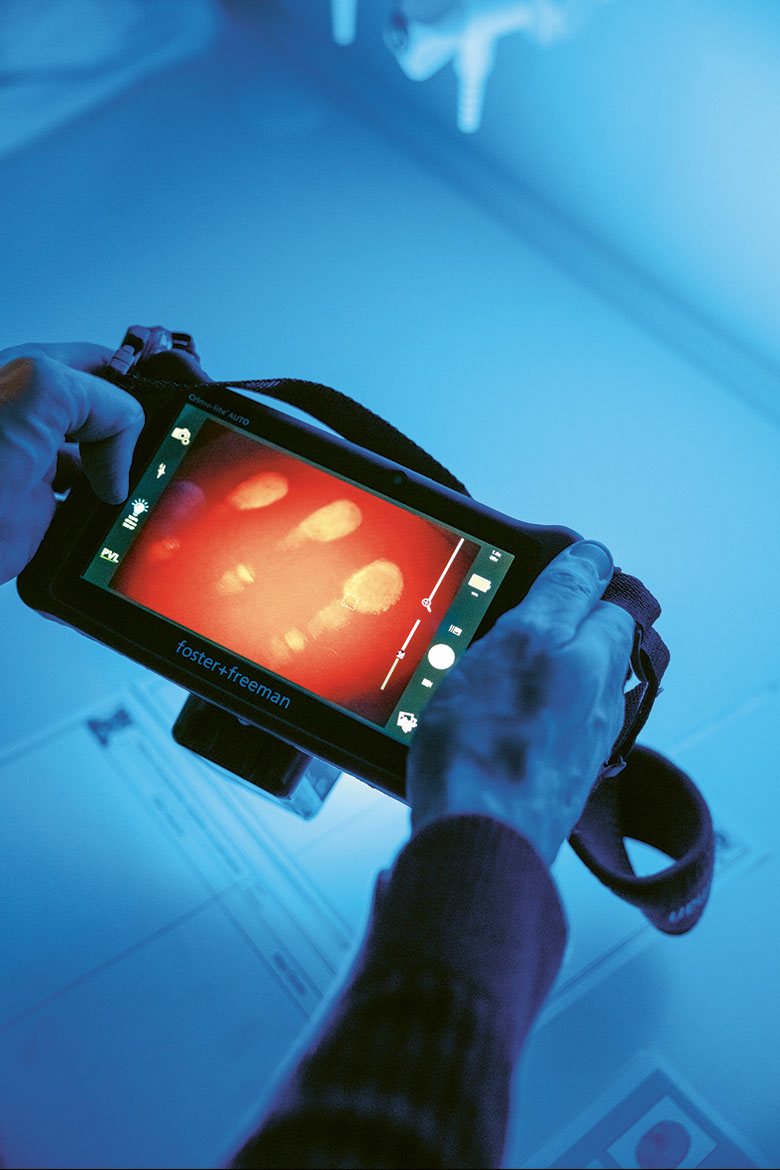
... fingerprints can be detected using laser light.
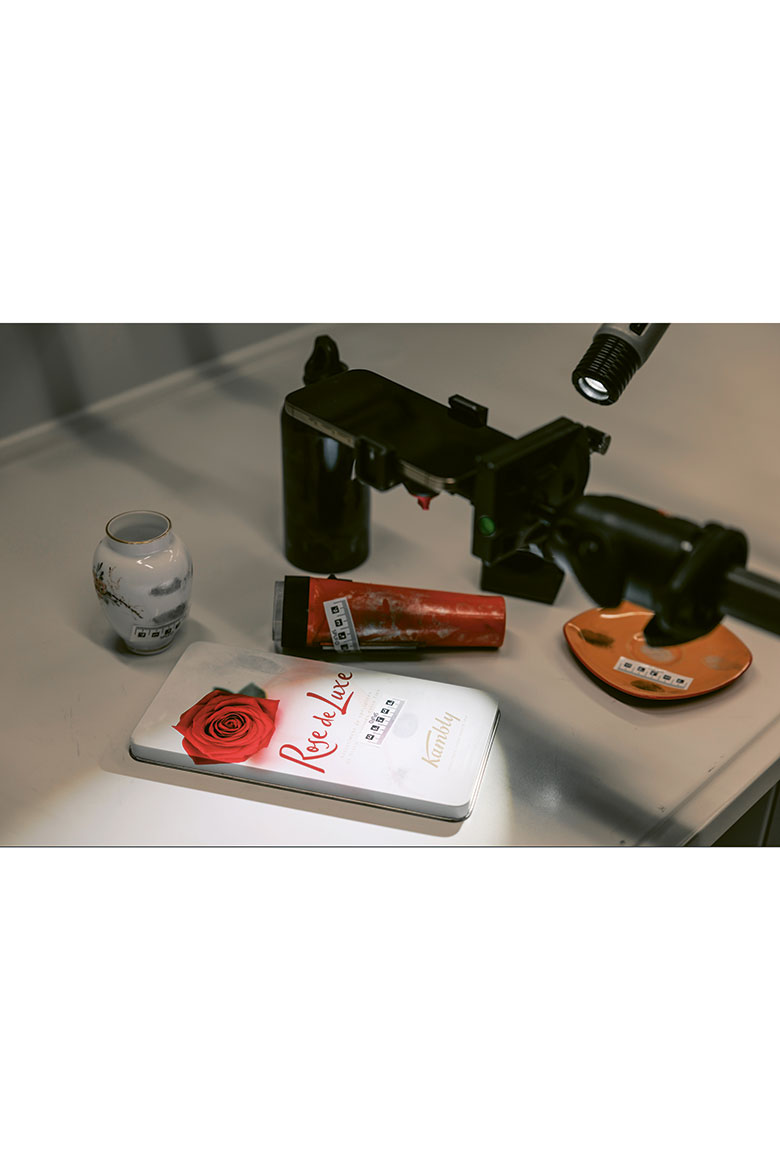
A smartphone is held over a box covered in fingerprints. This is to test whether police officers might in future be able to use their mobile phones to take photos good enough for forensic purposes.
Bonnaz looks at the bottles that are now covered in a chaotic mess of streaks and smears. “This is a typical case”, she says. Clear marks often come from greasy skin residue, while those that are less recognisable come from dry fingers or the movement of our skin on the object. Just how clearly a mark remains on an object also depends on what’s happened to it after we’ve abandoned it – time, moisture and the environment all play a role. When you’re involved on a research project aimed at evaluating detection methods, you have to assess thousands of such traces by eye. And it’s demanding work.
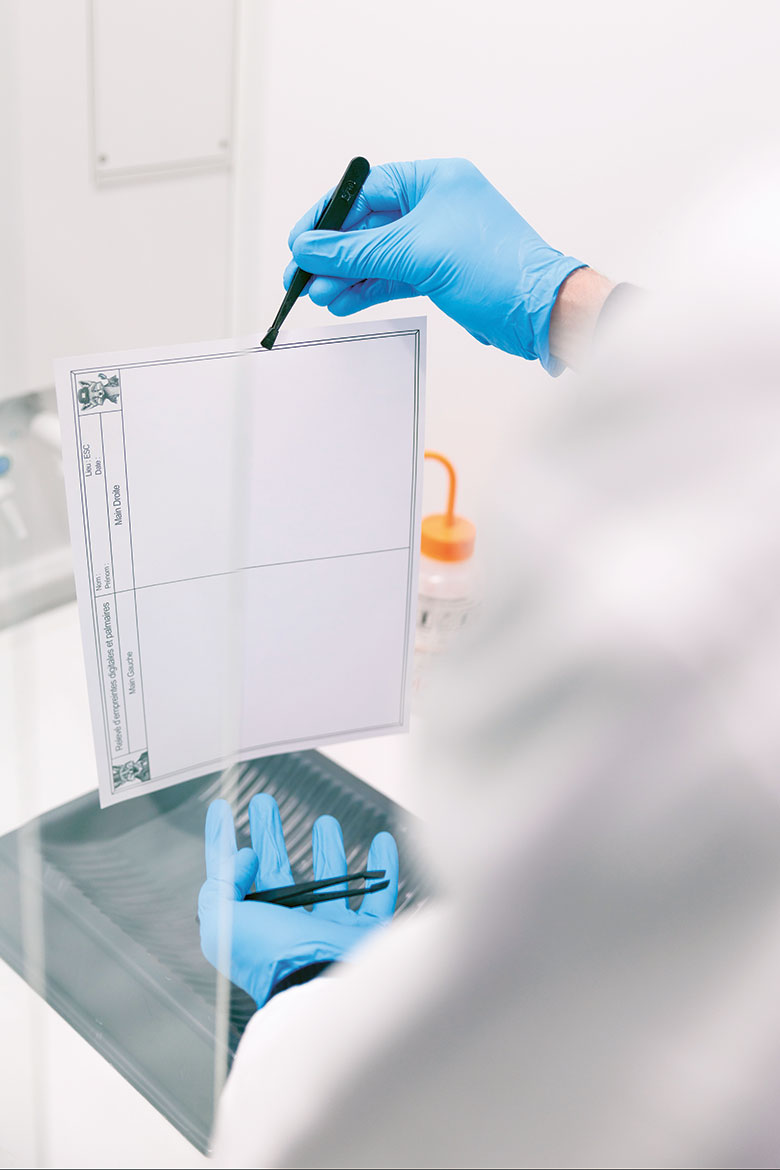
Next to the cyanoacrylate cabinet, there is a flat container full of liquid standing underneath an air vent. Bécue uses tweezers to pull a used sheet of paper through it. “It’s ninhydrin”, he says. It reacts with amino acids from the sweat exuded by our skin, and turns fingerprint remains purple. It’s a method that’s been in use, unchanged, since the 1950s.
Ecologically unfriendly solvents
But this tried-and-tested method has meanwhile been called into question. Ninhydrin solvents contain so-called forever chemicals, ‘PFAS’, which is why they were banned at the end of 2025. “Everyone knew that would happen eventually”, says Bécue, “but now the ban is here, and we haven’t yet found any equivalent replacement”. This is why he’s researching alternatives. Some of the ideas he’s investigated have shown potential, but the traditional mix of methods still remains unbeatable.
The current gold standard for detecting fingerprints on paper is a chemical called indandione. It, too, reacts with amino acids – but by forming a fluorescent substance that is only visible under laser light. The lab is increasingly dominated by a pungent vinegary smell that’s being exuded by the solution into which Bécue has just dipped another sheet of paper. Now he has to go to the darkroom next door, whose black walls are lit up by hundreds of glow-in-the-dark stickers. “I did that”, says Bonnaz with a laugh, “on a very long day in the lab”.
Before they turn off the lights, we all put on orange safety goggles. And when Bécue switches on the laser, dozens of bright orange fingerprints appear on what had until now seemed just a white sheet of paper. They’re razor-sharp and rich in detail.
“This is the best technology that we have today for porous surfaces such as paper”, says Bécue. “But here, too, we’re having to look for more sustainable, alternative solvents”.
Every fingerprint is different
To finish, Bécue and his team show us another facet of their work: artificial fingerprints that serve as control samples for testing different methods, making comparisons between different laboratories, and for training purposes. They have stamps, for example, to make reproducible, bloody fingerprints. “This is not really possible with real fingers”, says Bécue. “Even if a fingerprint ‘donor’ always used the same finger, it would be difficult for them to leave a series of traces that all have the same quality or composition”.
Bécue collects the stamps from the table and puts them in a plastic bag. When everyone’s taken off their blue gloves at the end of our visit, he laughs: “Maybe we should do another test to see who touched their face today!”.