Fake images causing real harm
Deceptively realistic AI images and videos are spreading rapidly today. Swiss researchers are now developing methods for tracing their origins and revealing how they’ve been manipulated.
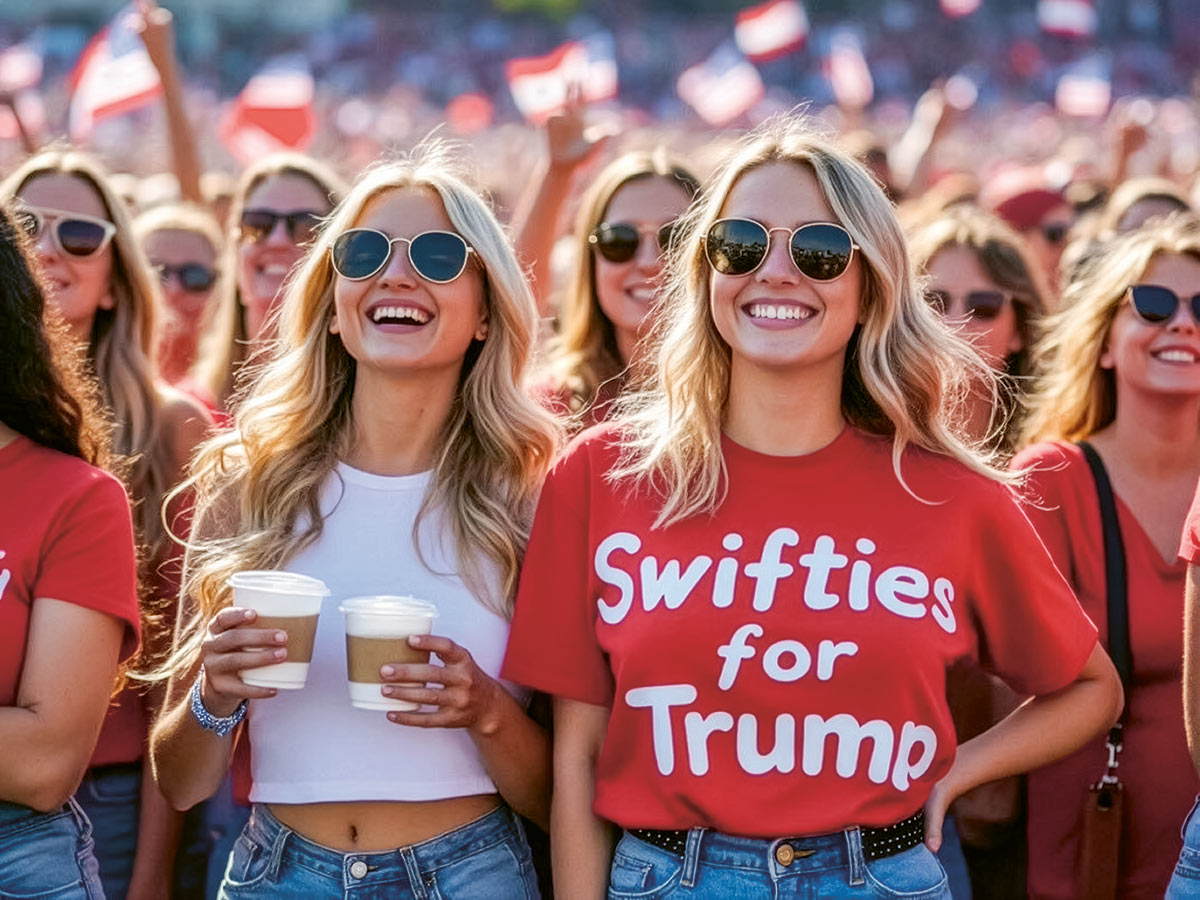
On the platform Truth Social, you can see Taylor Swift fans celebrating Donald Trump. They’re fakes generated by AI, but if we’re going to do anything about such cases, the AI industry itself will have to do its part. | Photo: AI-generated image / Truth Social
In mid-May 2026, millions of people watched live on social media as the streamer ‘Finnyzyy’ used artificial intelligence to expose a purported sex offender. Before chatting with the man in question, Finnyzyy used AI to transform himself in real time into what appeared to be a 14-year-old girl. This scene seemed so authentic that it was in fact deeply unsettling. Deepfakes have now reached a level of quality that makes it difficult to detect them, even for experts.
AI hunting AI
“It’s a never-ending game of cat-and-mouse”, says Touradj Ebrahimi of EPFL. “By the time a detection program has exposed a fake, the algorithms are already busy finding ways to circumvent the detection”. Ebrahimi’s work is focused on the authenticity and traceability of digital media.
“There are basically three different approaches to take when you want to detect AI-generated images”, he says. “You can try and detect them by identifying anomalies in the imagery; you can detect them through fact-checking; or you can label genuine content as such”. Ebrahimi’s team is mostly busy developing detectors. “We pit two AIs against each other: one has to generate images, while the other is told to distinguish these artificially generated images from real ones”, he says. In specialist circles, this is known as a Generative Adversarial Network (GAN). And it’s a strategy that’s yielding very promising results. In this battle of different intelligences, the AI detector’s ability to detect miniscule inconsistencies means it quickly learns to spot fakes.
Authenticity stamps for real images
Sébastien Marcel works at the Idiap Research Institute in Martigny, which describes itself as working to promote “artificial intelligence for society”. And he’s of the same opinion as Ebrahimi, adding that “verification systems like this are already being used for digital identity checks – such as when you open a bank account online”. He’s busy building extensive databases of real and artificially generated images that are used to create this kind of recognition system.
The problem in the AI race is that the other side is using the exact same technologies. Generative AIs are producing ever better fakes in ever shorter timeframes. “Detectors will always lag behind”, says Ebrahimi. Marcel agrees: “The development of deepfakes is accelerating so rapidly that it’s becoming more and more difficult to expose them in time”. Ideally, a deepfake ought to be detected within seconds, because experts warn us that social damage usually occurs within minutes of it being placed online. This is also why traditional fact-checking is now reaching its limits. It often just can’t keep up with the speed at which false images go viral.
And it’s not just the images themselves that are now being manipulated, but also their metadata – in other words, the information about their origin and processing. This is why researchers at ETH Zurich are adopting a contrary approach: they’ve started labelling genuine content instead. This comes in the form of developing sensor chips that sign images, videos and audio cryptographically at the very moment that they’re recorded. “We want to integrate this technology directly into cameras”, says Fernando Cardes, one of the joint developers of the signature. This could make it possible to verify whether content actually originates from a camera, and can state when it was made and whether anyone has manipulated it subsequently.
Deepfakes can be detected using technology, but these researchers doubt whether platforms or their users will actually use such tools consistently. They invest greater hopes in international standards such as ‘JPEG Trust’, which Ebrahimi is promoting in his capacity as the chairperson of an ISO committee. This particular standard bundles together an image’s origin, editing history and authenticity in order to create trust profiles for users.
There’s little time left to create common standards
This approach is compatible with the specifications of the Coalition for Content Provenance and Authenticity (C2PA), a global alliance that aims to establish common standards for provenance labelling. The Coalition’s members meanwhile include companies such as OpenAI, Meta, Adobe and Google, plus camera manufacturers and media organisations. But it remains moot whether or not such systems can become properly established in the long term. Technology can make a lot of things possible. But will these tools be deployed in time, and on a broad enough basis, before trust in digital media suffers lasting damage? That’s another matter entirely.