Safeguarding for success
Registering a patent contradicts the ideals of freely exchanging information among researchers. But those who want to bring their inventions to market still need them, and they have the backing of the universities.

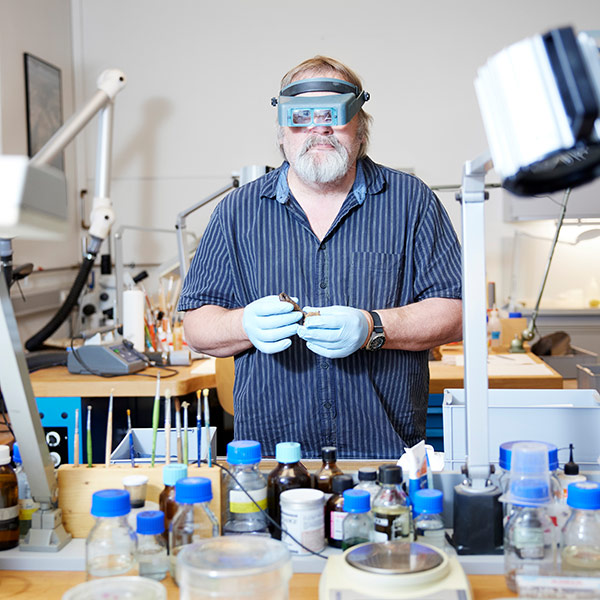
If a spin-off is going to have any chance of becoming a real unicorn – that’s a company worth over a billion US dollars – then the invention at its heart has to be protected from the competition. This is usually done with a patent. | Image: Lucas Ziegler
“How many patents do you think there are in a smartphone?”, asks Gaétan de Rassenfosse, provocatively. He’s a professor of science, technology and innovation policy at EPFL. The answer? Somewhere between 30,000 and 100,000. “But nobody knows exactly”. These dimensions alone illustrate just how central patents are to scientific innovation. When the US government passed a new law on intellectual property back in 1980, it also showed how important it is for a company to have the sole right to use an invention.
Companies need certainty
For the first-ever time, this so-called Bayh-Dole Act allowed government research institutions to grant an exclusive licence to an individual company to use university patents. Although this meant restricting the use of publicly funded inventions, the number of licences issued by universities increased as a result. “Nobody wants to invest work in something that is subsequently available to everyone”, says de Rassenfosse. This is especially important when research results are involved: “The technologies that emerge in laboratories are a long way from commercialisation, so they still require a lot of development”.
All the same, according to the patent expert Christian Moser, many find it difficult to take the step from problem-oriented research into the profit-orientated economy. He is employed by the Swiss Federal Institute of Intellectual Property (IPI), whose services include providing prospective start-up founders with information on whether or not they can protect their idea with a patent – and if so, how. The most important point to note is this: the moment that an invention becomes public knowledge, whether through a lecture or through publication (whether in an article or in digital channels), it’s no longer considered new, so it can’t be patented any more. “Too many inventions lose their patentability because their inventors publish them too soon”, says Moser. This is why he is trying to raise awareness of intellectual property issues by giving lectures at universities, technoparks and start-up incubators.
When you register a patent, you’re protecting future products from being copied by your competitors. This can ensure the business success of a spin-off company and its investors. It’s also important to make sure that your own company isn’t infringing the property rights of others. Besides patents, these can also include trademark rights, design rights and copyright. This is why the IPI helps people to clarify whether their chosen path is free, and where exactly it might take them. This is known as ‘freedom to operate’. Moser sums up the situation quite simply: “When it comes to business, there are only two forms of intellectual property: your own and everyone else’s”.
But just who owns a patent is somewhat more complicated in the case of university research. It doesn’t only belong to the researchers who’ve invented something, but to their employer – the university. The researchers are merely listed as the inventors on the patent application – in other words, they get the fame and the glory. As a rule, universities retain all patents and only grant licences to use them – even to companies that are spin-offs founded by their own researchers. “In this way, we are able to prevent patents from being bought and then hidden away, just to keep the competition at bay”, says Cornelia Fürstenberger. She is the technology transfer manager at Unitectra, a technology transfer office run jointly by the Universities of Basel, Bern and Zurich.
Almost every university has such a specialist centre that serves to make inventions available in way that promotes their further development. The idea is to encourage researchers to apply for patents and to receive the proper support in doing so. However, many researchers are not aware of this. “We are delighted when people approach us at an early stage”, says Fürstenberger, “because then we can point them in the right direction”.
Technology transfer offices have to be able to give precise answers to assorted legal and commercial questions: What exactly is this invention? Who was involved in it? Was material from others used in it? Is there a market for it? These questions are followed by a meeting with the inventors at which all involved parties should be present. This is where the decision is made as to whether a patent application might be possible, whether it is worth the effort, and, if so, what the possible product might look like in the end. “That’s important to know, because a patent ought to cover future products as comprehensively as possible, especially if it’s intended to help create a spin-off company”, says Fürstenberger.
Just behind Swatch, but ahead of Nestlé
The university covers the costs of registering the patent. Where a spin-off company is founded, then the university customarily secures a share of its turnover, and will hold a stake in the company itself. Overall, the universities come out of this with a positive financial balance. Fürstenberger insists, however, that the aim of technology transfer offices is to make a contribution to society, not to earn money. In total, Swiss universities filed a total of some 300 patents in 2021, putting them in second place in the country, just behind Swatch and well ahead of Nestlé, Philip Morris and Roche.
All the same, a patent isn’t the right solution for everyone or for everything. “Biotech and med-tech start-ups can’t function without patents”, says de Rassenfosse. But it’s different in the IT sector, where companies exist without patents. As with texts and images, copyright automatically applies to computer code. And there’s a lot of information that is simply a trade secret, with companies themselves in charge of ensuring that it remains protected – such as the training data used for AI applications. This is the complete opposite of a patent, which the authority publishes but which can be used to guarantee a spin-off company has a temporary monopoly, i.e., long enough to develop its product for the market.