Mini-organs are conquering the lab
Small clusters of cells function in a remarkably similar way to entire organs. These ‘organoids’ are opening up new possibilities for biology, personalised medicine and drug development. And, not least, they offer the prospect of less animal testing.

Little hollow spheres grow in drops of gel that allow researchers to conduct experiments in parallel. | Infographic: Janine Wiget
1. Growing a cluster in a drop of liquid
Like so many other groundbreaking scientific discoveries, this one too began with a failed experiment. It belonged to Madeline Lancaster, at the time a postdoctoral researcher, who was trying to grow stem cells from a mouse’s brain overnight at the bottom of a Petri dish. But the next morning, she found only a cloudy liquid – which is usually a sign of dead cells, as she later explained in a Radiolab podcast.
When she looked closer at the dish through a microscope, Lancaster found something astonishing. In the culture medium, the cells had spontaneously clustered together to form small lumps. And as the days passed by, these clusters became more and more like those of a brain. For more than 15 years now, these tiny clusters, called ‘organoids’, have been taking laboratories around the world by storm. Researchers are now creating not just ‘mini-brains’, but also mini-versions of many other organs such as the liver, lungs, kidneys, intestines and retina.
Replacing toxicity tests in mice
When developing active ingredients, pharmaceutical companies have to monitor any side effects early on so that they can still make modifications wherever necessary. This is why InSphero uses liver organoids that can help detect the toxic effects of substances. The US Food and Drug Administration (FDA) already accepts some tests of this kind when assessing whether to approve human trials. Until now, drugs had to be tested in advance in animals. It’s possible that organoids will soon be more widely accepted by authorities. “In a test involving some 150 drugs that had already been approved, our system identified eight of the ten substances that later had to be withdrawn from the market because of the side-effects they triggered”, says Olivier Frey.
These organoids harbour immense potential for basic research and for biomedicine because their three-dimensional structures are much closer to actual conditions in the body than the flat cell cultures that used to be the norm. Just like real organs, they consist of different types of cells that arrange themselves into organised structures and communicate with each other.
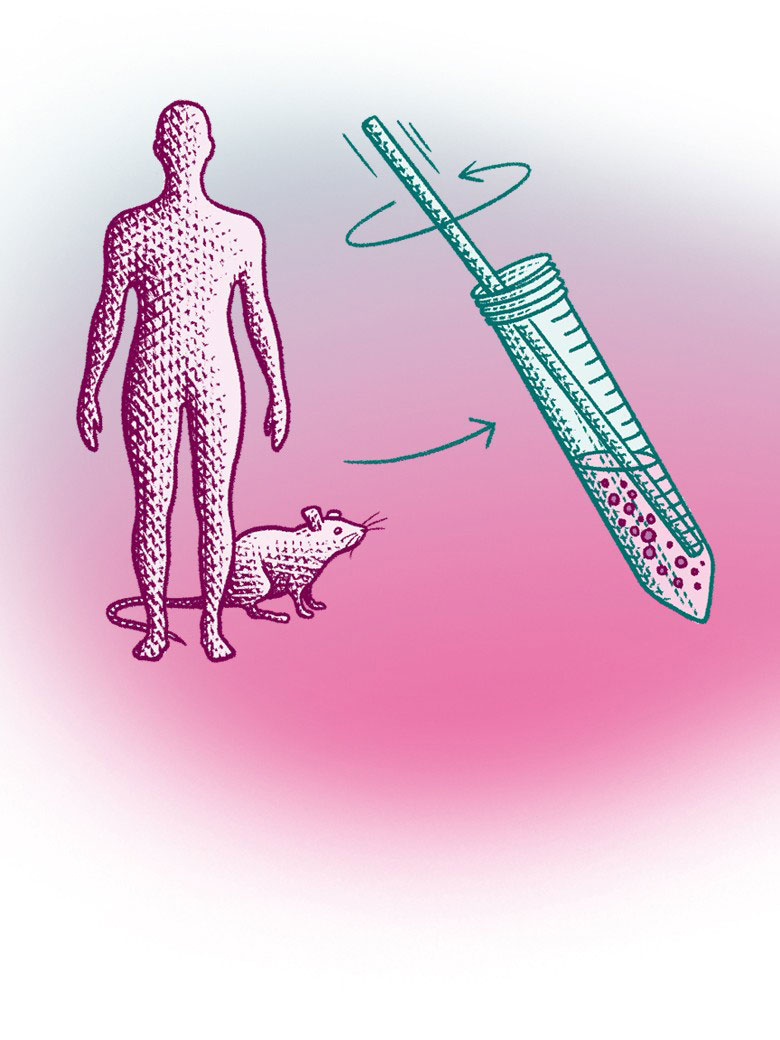
1) Researchers take tissue from biopsies from humans or lab animals and use them to create organoids. To do this, they dissolve the tissue and separate it into its constituent parts. | Illustrations: Janine Wiget
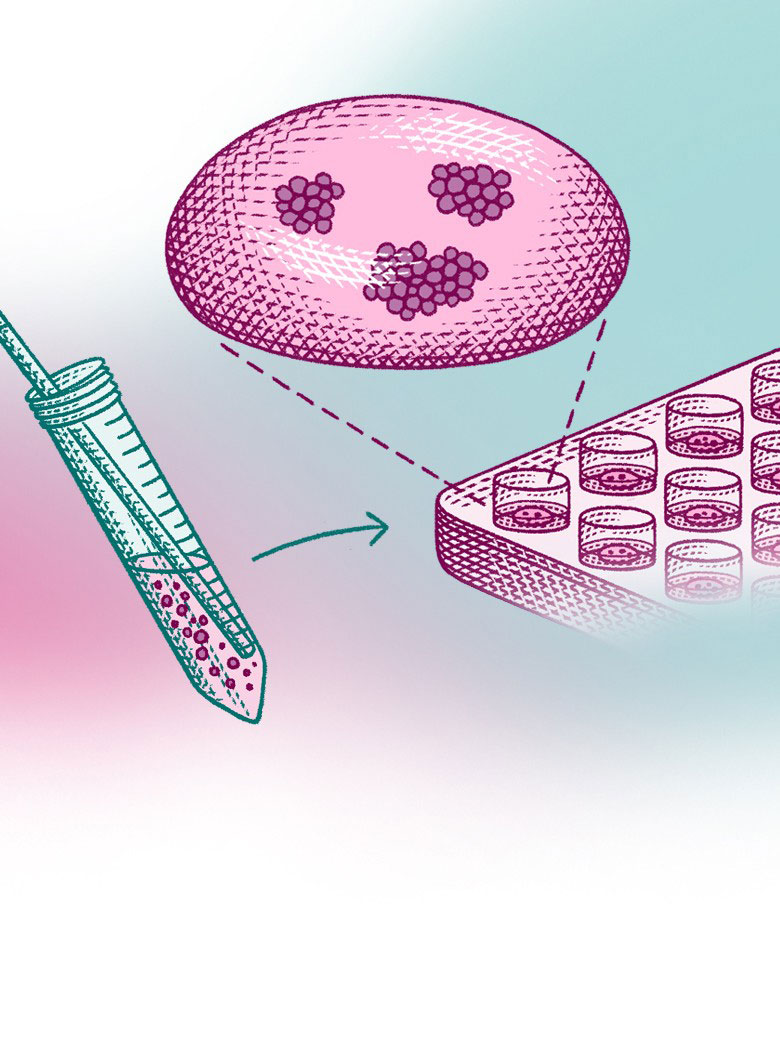
2) The cells are placed in a drop of gel, where they grow and cluster in lumps.
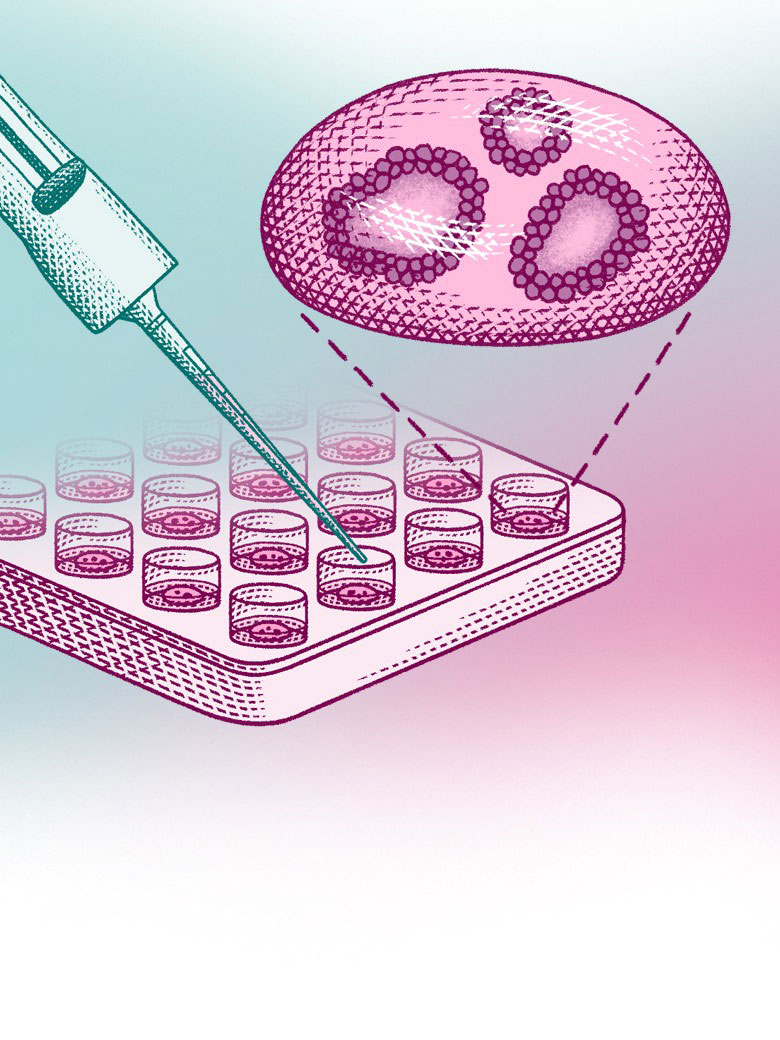
3) The researchers add signalling molecules to give the clump of cells the right instructions. The cells then start to organise themselves and to specialise, forming a hollow ball that can also assume other, more complex forms: an organoid.
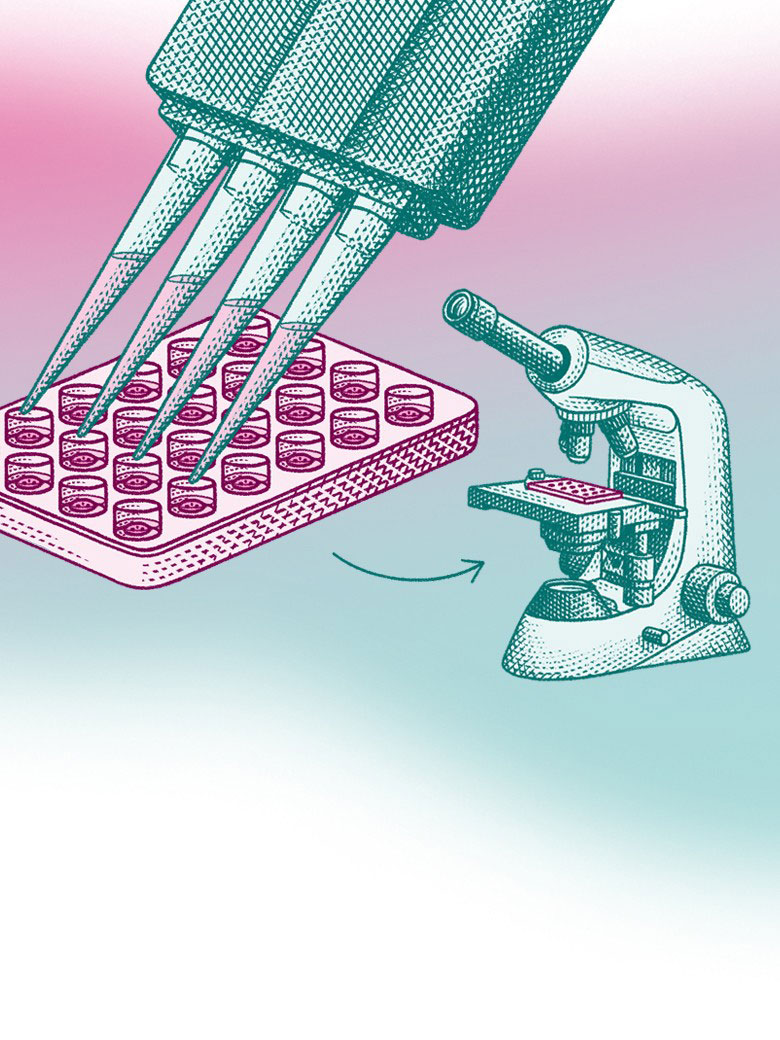
4) The researchers use these organoids for their experiments. For example, they can observe the cells marked with a dye under the microscope.
Their similarities to real organs are often astonishing. For example, a heart organoid has tiny chambers inside and beats in the same rhythm as a real heart. From all sides of intestinal organoids grow small projections that are structured exactly like the so-called ‘intestinal villi’ that enable the small intestine to absorb nutrients. And nerve cells in brain organoids send electrical signals to each other.
Producing organoids requires delicately devised recipes, each of them tailored to the desired end product. “This involves a great deal of effort and experience, but it’s also a bit of an art”, says Olivier Frey, a vice-president of the ETH spin-off company InSphero, whose services include selling organoids of the liver and intestines. “Our aim is for the organoids to represent the function of the original organ as closely as possible”.
Organoids can be produced from various source materials. Their production often begins with stem cells, as they hold the potential to develop into any of a broad range of cell types. A method has been in use for about 20 years that enables so-called ‘pluripotent’ stem cells to be produced from connective tissue, for example. Alternatively, organoids can also be produced from tissue samples, such as those taken during biopsies.
To do this, the researchers often place the cells into a drop of a gel-like substance that itself contains a kind of scaffolding that encourages the formation of cell clusters. Then a sophisticated mixture of nutrients and signalling molecules determines whether these clusters will develop into a mini-liver, a mini-pancreas or a completely different organoid.
The process that turns individual cells into a structured organoid measuring just a few millimetres across can take weeks or even months. During this time, the culture has to be nurtured carefully and monitored.
2. First steps to medical use
Another advantage enjoyed by organoids – besides their similarity to real organs – is that they can be produced from human cells with ease. Science has long been limited by the fact that research cannot be conducted directly on human organs. And the conventional cell cultures that stick in a thin layer to the bottom of a Petri dish are far removed from the actual conditions inside the human body. This is why researchers often conduct experiments on mice and other animals that have been genetically modified to exhibit symptoms of disease similar to those found in humans.
Comparing healthy and sick brains
About half of the brain consists of glial cells, whose tasks include providing energy to neurons. The EPFL spin-off GliaPharm is now replicating this process in organoids consisting of neurons surrounded by glial cells. They have been using this approach to test a drug designed to treat the rare genetic disorder GLUT1-DS, in which energy deficiency leads to epileptic seizures. To do this, they compare the electrical activity of brain organoids from healthy and affected individuals. According to Charles Finsterwald, GliaPharm’s co-founder and chief scientific officer, this drug may also help alleviate conditions such as Alzheimer’s or depression, where the energy supply to neurons can also be impaired.
“It was always very important to me that we should be able to conduct research on a human system”, says Ralph Müller, a professor of biomechanics at ETH Zurich. He’s interested in how bones form and break down again – such as in cases of osteoporosis. His team has succeeded in replicating part of these processes using organoids of human bone. To do this, they print a fine lattice using a gel containing bone-cell precursors.
These bone cells are then fed minerals and nutrients. Their lattices are gently pressed together for several minutes, three times a week. This simulates the mechanical stress that’s necessary for bone formation. “After about four weeks, we’ve got a well-mineralised scaffolding that has been colonised by living cells that are communicating with each other. In humans, this process would take three years”, says Müller.
Müller uses these resilient organoids for basic biological research in his laboratory. This work has also spawned a spin-off company called Compagos that aims to use bone organoids in medicine. For example, they could help in the search for new drugs to treat the rare hereditary condition known as brittle-bone disease, or in diagnosing metastases in bone cancer. And perhaps, in the future, this process might even help to accelerate the regeneration of damaged bones.
Compagos is by no means alone in pursuing these ideas. Numerous other start-ups have also begun investing in this new technology, as have the big pharmaceutical companies. Organoids are already being used for the preselection of new active substances, for toxicological tests and for personalised therapies. People also hope that organoids will one day revolutionise transplant medicine.
Genetically identical replacement tissue for organs could perhaps be grown from a patient’s own cells, thereby removing potential rejection as a problem. Initial steps in this direction have already been made with the so-called islets of Langerhans in the pancreas, which are damaged in people who have diabetes. In their natural form, they are already similar to organoids.
3. Automation, standardisation, industrialisation
“With any new, disruptive technology, there’s always an explosive development at the beginning, especially in research. Then comes the transition to industrial applications”, says Gilles Weder, the head of research and life sciences at CSEM’s centre for technology and innovation in Neuchâtel and Allschwil (canton of Baselland). His team is working together with numerous start-ups and pharmaceutical companies in order to take organoid applications to the next level.
This includes developing automated systems for cultivating and maintaining a large number of organoids – because doing it all by hand is immensely time-consuming. That is why pumps, tubes and pipette robots are now assuming responsibility for the job. They can tend to hundreds of organoids growing in the recesses of plates kept in the laboratory.
Personalised cancer therapy
Every tumour is different, so the challenge is to find the best individual treatment for every patient. Mohamed Bentires-Alj is researching into breast cancer at the University of Basel. He explains how organoids can already help on a small scale. His team cultivates patient-specific tumour organoids from biopsy tissue, then tests the impact of different drugs on their growth and survival. This can help when deciding between equally valid therapeutic options, thereby sparing patients from undergoing a therapy that might be ineffective and have side-effects. This method is still only applied in specific cases where the disease is severe. This is because no large-scale studies have yet taken place that provide the necessary statistical evidence of tumour organoids actually responding to a drug in the exact same way as would a tumour in the patient.
Visienco is a start-up company that developed out of CSEM and has created a device to identify and remove poorly developed organoids swiftly. It ensures that they are all the same size and at the same stage of development. This process of standardisation is especially important for applications in the pharmaceutical industry, such as toxicological studies or research into a drug’s mode of action.
Conducting and analysing tests with organoids can also be automated. Tests can involve measuring the electrical activity in brain organoids, counting dead cells or quantifying fluorescence. AI is often already employed to help analyse the vast amounts of data that are generated. It’s essential that procedures should be subject to greater standardisation and validation, especially if organoids, as hoped, are going to reduce the number of animal experiments being conducted.
But if they are going to achieve success, organoids will have to reflect reality even more accurately than they do at present. This work is currently underway. Lots of research teams are trying to cultivate organoids that form blood vessels and are enriched with immune cells, which would provide for an even more accurate approximation of the physiological micro-environment.
So-called ‘organs-on-a-chip’ also promise greater accuracy in this regard. They feature different types of organoids placed in recesses on a plastic chip and connected to each other using microchannels. It enables the simulation of an exchange of substances between several organs through the blood. According to Olivier Frey, however, experiments with these chips are still extremely complex at the moment. This is why they are still found more often in a research environment than in industry.
But perhaps it’s not even desirable to get too close to real physiological conditions. Some people fear that electrically active brain organoids could develop a consciousness of their own, which would raise whole new ethical issues. But Gilles Weder is insistent that there’s no danger of that happening any time soon. It’s true that organoids possess astonishing capabilities, he says. “But they only have a limited number of functions and demonstrate nothing near the complexity of a living organism”.