Chemistry with just one atom
Particle accelerators produce chemical elements that have never been seen before. These experiments last just one second, but they nevertheless touch on matters of international prestige.

A new particle accelerator is being built in Darmstadt and is due to start running in 2032. It’s going to look for further heavy elements – and scientists are hopeful of finding them. Photo: Maximilian Mann / Laif / Keystone
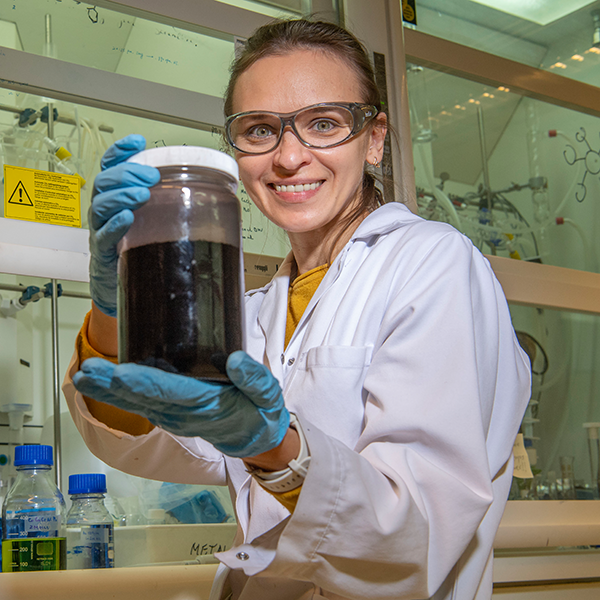
Patrick Steinegger is a chemist who works at the Paul Scherrer Institute (PSI) and ETH Zurich. And he’s hunting for the most mysterious, the heaviest, the most fragile atoms in existence. They lie at the end of the periodic table, with the highest atomic number currently occupied by oganesson at 118. “It’s the rarest element on Earth”, says Steinegger. Since it was discovered 20 years ago, just four atoms of it have been detected. “We really know nothing about its chemical properties”, he says.
Many atoms at the top end of the periodic table – in other words, those that have many protons in their core – simply disappear after being produced, before anyone can study them. This is what researchers like Steinegger want to change. They want to investigate just how these short-lived atoms behave. For example, they want to know whether oganesson belongs in its place on the periodic table. Is it really an inert gas like helium or radon? Steinegger’s working at the very limits of what we can measure. “Studying superheavy elements requires the most sensitive analytical methods in the world”, he says. It’s conducting chemistry with just a single atom.
But before they can study one of these atoms, the chemists have to produce it. All superheavy elements are created artificially in particle accelerators, where ions like calcium are fired at thin foils with elements such as plutonium. But they rarely fuse. The heavier the element, the lesser the likelihood that it will be produced – and the faster it will decay. Roughly 100 researchers are working in this discipline across the world today, and they’re focused on elements 105 to 118.
Packing up every bolt
Steinegger is currently concentrating primarily on element number 113: nihonium. “The atoms need to exist for about a second for us to do our experiments”, he says. The PSI can’t produce superheavy elements, so he has to pack his detectors in crates and travel to the few facilities on the globe that can produce them. That used to mean going to Dubna in Russia, where he worked over many years, and where oganesson was discovered in 2006. Today, he’s more likely to travel to Berkeley in California, to Tokyo or to Lanzhou in China. “We take every single bolt with us”, he says. “That’s because every country has its own norms for these things”.
As soon as a superheavy atom emerges, the actual work of the chemists begins. First, they have to separate it from by-products, then slow it down in a gas, and finally pass it over a surface made of silicon dioxide or gold. “It’s precision work”, says Steinegger. They record the decay of the superheavy elements. The temperature at which they deposit it on the surface enables the chemists to calculate the binding energy, which in turn allows them to determine issues such as whether they have detected an inert gas or a metallic bond.
Trying to find the ‘island of stability’
The problem is that the three heaviest known elements decay before they can reach the detector in any chemical experiment. Oganesson, for example, survives for less than a millisecond. This is why the chemists need faster methods. “In principle, you have to create a separate experiment for each element”, says Steinegger. But there are many unanswered questions. While oganesson is thought to be an inert gas, theoretical calculations suggest that its high nuclear charge could make it significantly more reactive than its lighter relatives. It might not even be a gas at all.
Just how difficult it is to predict anything about these elements is illustrated by the famous ‘island of stability’ – a purported set of longer-living elements that could lie at the end of the periodic table, and for which researchers have been hunting for decades. “We’ve reached the shore, but we don’t know how far it extends”, says Christoph Düllmann of the Helmholtz Centre for Heavy Ion Research in Darmstadt. His institution is aiming to open a new accelerator in 2032.
“Discovering a new element is guaranteed to get people’s attention”, says Düllmann. And that encourages competition. What fascinates him about his research, he says, is that he’s working at the very boundaries of the periodic table, on the frontiers of the possible. Is there even an absolute limit? The existence of element number 173 is often mentioned. So there’s plenty of work left for future generations, he says, laughing.