Large networks of support cells in the brain
Astrocytes are support cells that communicate with each other by exchanging substances. Researchers have now visualised their far-reaching networks for the first time.

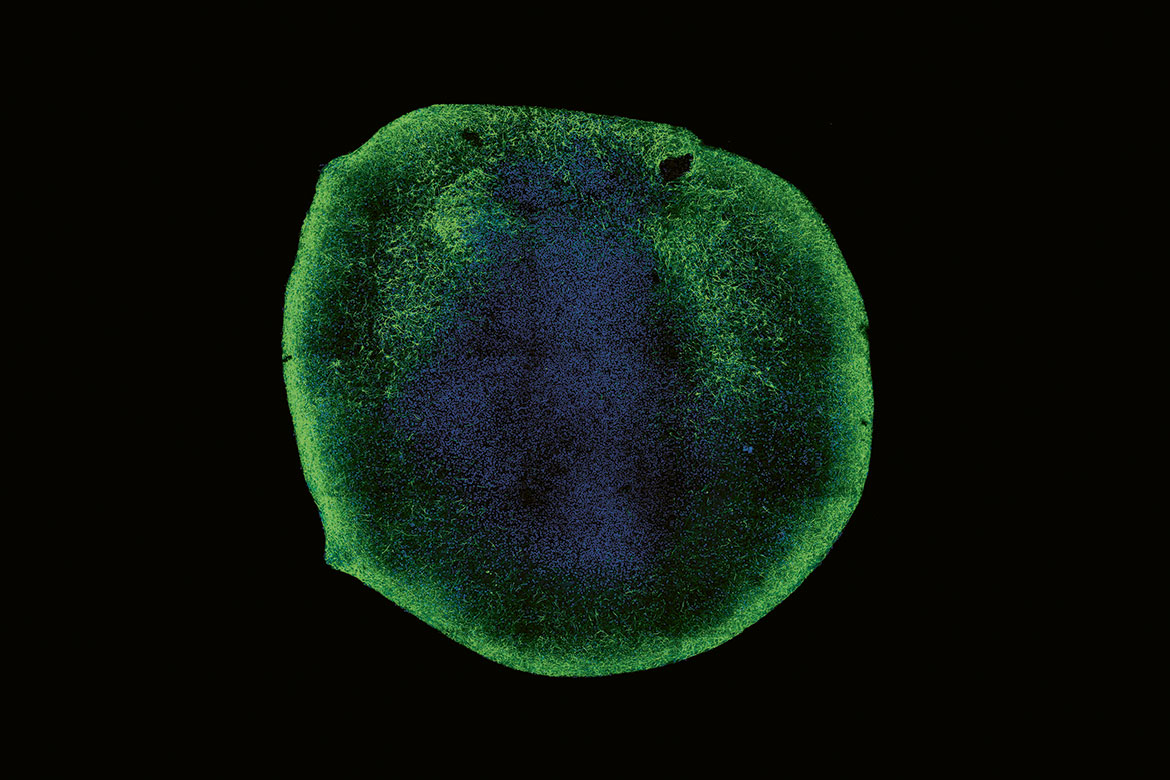
A mouse brain has here been infected with a virus that introduced the blueprint for a protein into the support cells at the site of injection (see the arrow). This protein leaves a trail as it travels from cell to cell, though initially only at the injection site (blue, left). But the network of support cells enables the protein to reach a large part of the brain (pink, right). | Photo: adapted with permission from Cooper et al. (2026).
For a long time, astrocytes in the brain were understood to be support cells that perform the role of a biological janitor. For example, they supply nerve cells with energy, remove metabolic waste and regulate the blood flow. But now, for the first time, using an intact mouse brain, researchers have been able to visualise in three dimensions the extent and specificity of how astrocytes connect to each other within their networks. “Some of these connections extend into the other hemisphere of the brain, and we’ve even found them between regions of the brain whose nerve cells aren’t connected to one another at all”, says Aiman Saab of the University of Zurich, who co-authored the study in question.
Unlike nerve cells, astrocytes don’t communicate using electrical signals, but instead utilise tiny channels to pass molecules from one cell to another. Saab’s co-author Melissa Cooper, who is based at New York University, made use of this fact by means of a clever trick. In specific regions of the mouse brains, she infected astrocytes with harmless viruses that carried the blueprint for a certain enzyme. Once the cells had produced this enzyme, it was incorporated into the aforementioned channels and labelled all the molecules passing through it with a marker. This allowed the researchers to track the path of these marked molecules from one cell to the next, making the networks visible and enabling their three-dimensional representation. The mice had been given the marker in their drinking water for a week.
The research team also wanted to find out whether these networks could adapt to altered circumstances. To this end, they shortened the whiskers on one side of the mice’s faces. And lo and behold: after a few weeks, the astrocyte networks in the corresponding area of the brain were smaller and had been organised differently.
It’s possible that networks like these can aid the brain to distribute metabolic by-products or protective molecules over greater distances – such as when the local energy supply is disrupted. “Perhaps we’re dealing here with a kind of backup system for the brain”, says Saab. This is something that he’d like investigate more closely in future.