Feature: Start-ups in business heaven
Different terms
Anyone interested in the world of start-ups will soon find themselves confronted with odd vocabulary. We offer a brief glossary.
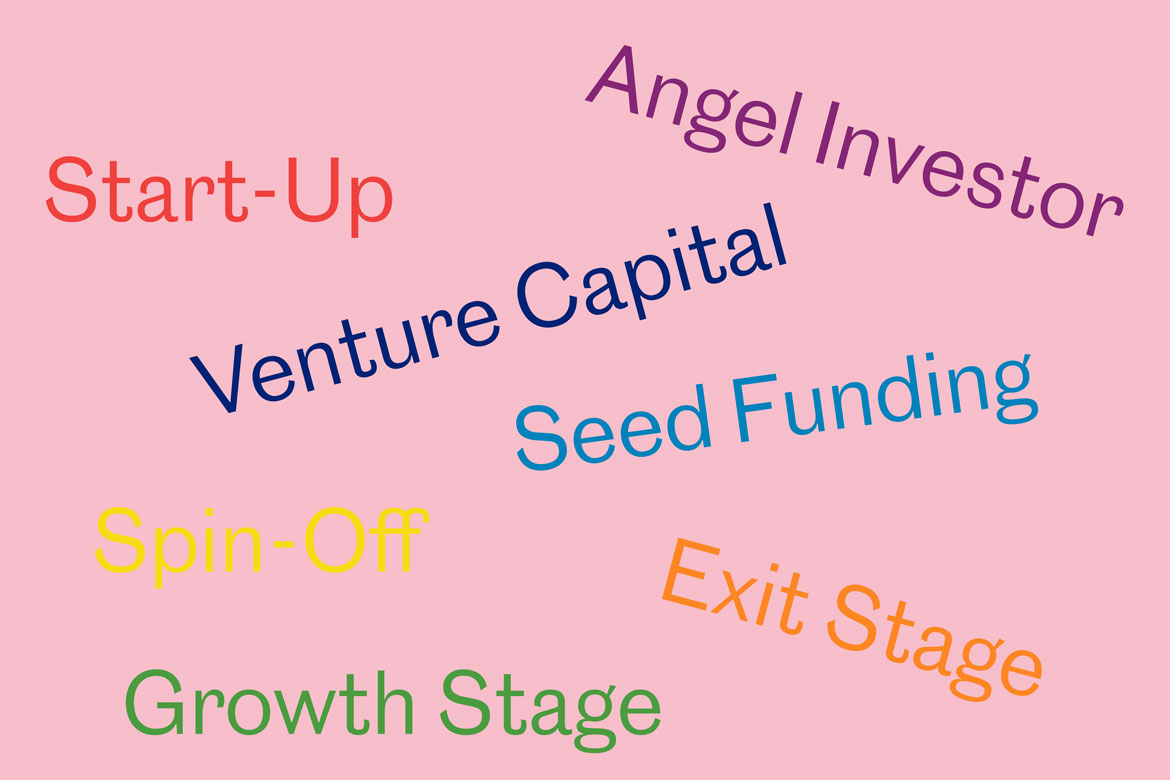
The vocabulary of start-ups ranges from the banal to the fanciful. But it all comes down to a few simple questions: Where are we coming from? Who’ll give us the money? How far have we come? | Illustration: Bodara
Start-up or spin-off?
A start-up, quite simply, is a young company that was founded less than five years ago. When such a company emerges out of an existing, larger company or a university, then we call it a ‘spin-off’ – rather like a particle that spins off from a larger body. A typical spin-off would be a company founded by researchers to develop discoveries they’ve had patented by their university. It’s these companies that are the focus of our current Feature articles.
Endless funding rounds
When you found a company, you need more than just a good idea. You need money. The so-called 3Fs typically come into play here – friends, family and fools. The last of these applies because you’d need to be crazy to believe in the future success of a spin-off at this stage. You’ll also need a prototype quite early on, and for that you need seed funding so that what you ‘sow’ can sprout. This typically comes from a ‘business angel’: someone rich who’s happy to take the financial risk. Later, there’s a sequence of further financing rounds that in the start-up world are listed according to the letters of the alphabet. The money in these comes from private individuals and companies who want to invest their ‘venture’ capital as profitably as possible. Long-term investment then often comes from a big, financially strong company that buys the start-up. An alternative is to go public with your own company – that’s an IPO, or Initial Public Offering.
The most important phases of life.
A start-up develops according to a series of funding rounds. The Basel Area Business and Innovation Agency divides them up into six different stages.
- Pre-Seed
During the pre-seed stage, the market has to be analysed and the business plan drawn up. - Seed
During the seed stage, the prototype is created and the initial funding secured. - Early
The aim in the early stage is to acquire clients and embark on funding rounds. - Growth
In the growth stage, the team expands, larger markets are targeted and more investors sought. - Expansion
In the expansion stage, the company should be able to stand on its own two feet and expand into the global market. - Exit
In the exit stage, the company is sold or goes public. But companies often don’t make it this far. Failure is simply part of the process.