
Insatiable AI
AI capabilities are expanding massively, as is their environmental impact. Companies are reluctant to publish figures, but the trend is clear: the footprint of AI is growing exponentially.
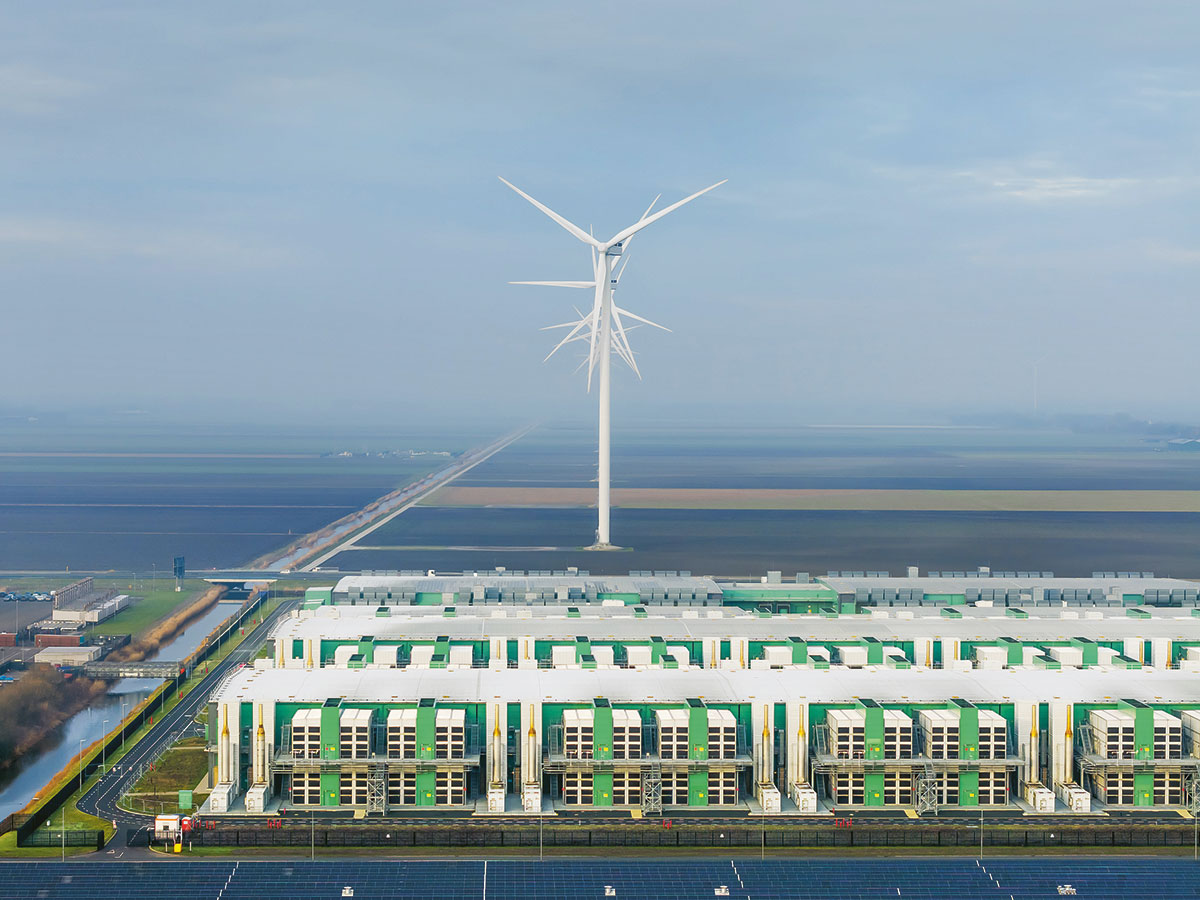
This Dutch data centre also needs a lot of electricity. | Photo: Mischa Keijser / Westend61 / keystone-sda
In 2009 a Google search used up about 0.3 Wh of electricity, the same as a 60-watt bulb lit for 18 seconds, according to the company itself. Surprisingly, the energy consumption of a standard prompt in ChatGPT is the same, according to the NGO Epoch AI. It’s a beautiful illustration of the improved energy efficiency of data centres.
This is only an average estimate, however. The actual energy expenditure of a prompt depends on its complexity, the time the AI spends responding to it and the model used. It increases with the number of artificial neural network parameters, which goes, for example, from 10 to 400 billion in the case of the different versions of the open-source model Llama 3.1. Figures for ChatGPT are not public.
Switzerland the champion of data centres
The gains in efficiency do not, however, compensate for the exponential growth in the use of digital tools, which are fuelled in particular by AI. In the United States, the electricity needs of data centres remained relatively stable between 2014 and 2016, then increased faster and faster, tripling in less than ten years, according to a report by the Lawrence Berkeley National Laboratory at the end of 2024. They reached 180 TWh, or four percent of national demand.
AI accounted for a quarter of this data infrastructure consumption in 2023 and is expected to reach half by 2028, ahead of cryptocurrencies. By then, the energy expenditure of training AI models should exceed that of their use. The predictions of the International Energy Agency are similar, with global data centre consumption expected to triple or quadruple by 2035.
This trend is seen in Switzerland too. Computing centres accounted for 3.6 percent of national electricity demand in 2019, 6–8 percent in 2025, and could reach 15 percent by 2030, according to an SRF survey. “Switzerland has opened its doors to data centres”, says Louise Aubet, the head of research at Resilio, a French-speaking consultancy on digital environmental impact. “Relative to its population, it has the second largest number in Europe. It exports many cloud computing services”.
While many European countries are net importers of digital services from Silicon Valley, in particular, Swiss exports compensate for imports from abroad. Consequently, “the environmental impact of digital services in Switzerland is roughly the same, as it is quantified based either on national consumption in the country, which includes imports, or in relation to their production in the country, which includes exports”, says Aubet.
We must not forget ‘grey’ energy, which is linked to the manufacture of computer equipment. This is why Denisa Constantinescu at EPFL is studying when a computer centre should renew its technical infrastructure with advanced models that are less economically and ecologically greedy. “In Switzerland, electricity is quite expensive, which encourages changing chips after less than four years”, she says. As electricity production is more than 95 percent free of direct CO2 emissions, however, there is relatively little climate benefit in reducing energy needs”. The situation is reversed in China where electricity is cheap, though its average carbon intensity is ten times higher than in Switzerland. Economically, the advantage lies in changing hardware only every seven years. If it were done so two years earlier, however, related CO2 emissions would decrease by 98 percent. “This is the fundamental problem: ecological and economic incentives are often not aligned”.
Several tons of toxic metals
Energy is just one of the impacts of AI. The manufacture of electronic chips necessary for the training of models and their use requires large quantities of materials. How much exactly? “Companies do not disclose precise information on this subject”, says Falk, who studies the environmental impact of AI at the University of Bonn in Germany. So she decided to find out herself. With her team, she dismantled the circuit board of Nvidia’s A100 GPU, reduced its components to powder and processed the samples chemically to determine the chemical elements and quantities using emission spectroscopy.
The result showed that it contains 32 different elements, including heavy metals and potentially toxic substances, e.g., arsenic, antimony and copper. The study estimates that the training of ChatGPT-4 (released in 2023) may have required some 5,000 A100 cards, each over one kilo in weight and necessitating the extraction of several tons of toxic metals. “The problems include the health hazards during the mining of materials, which is still often done in an artisanal manner, as well as the risks to the environment once the components are discarded,” she says.
The EU has passed regulations on e-waste, but again the figures are missing. “Companies say they collect used chips, but don’t say what they do with them. It is therefore not known if they are recycled or incinerated, or if they end up in official or wild landfills”. The trend is upward: Nvidia’s B200 chip released in 2024 contains 200 billion transistors, four times more than the 2020 A100 model. It also costs three times more, around $30,000 per unit.
Comparing apples and oranges rightly
It seems difficult to compare the different types of environmental impacts of AI, because they are quantified in very different ways: for electricity in kWh, for the climate in CO2 equivalent, for water consumption in litres, and for resources and pollution in tons of material. Nevertheless, there’s a way around this by standardising the different impacts of AI in relation to the nine planetary limits not to be exceeded to maintain the balance of our environment, says Aubet, whose work at Resilio included an analysis of the life cycle of the digital sector in Switzerland.
With 220 kg of CO2 equivalent per person in Switzerland, the digital sector represents 22 percent of the national carbon budget available in order not to exceed the global climate limit, set at a one-degree Celsius warming. It exceeds its contribution to the global limit for fine particles (13 percent), but remains less than that for freshwater pollution (38 percent) and for raw material resources (65 percent). The forecasts are alarming too. Within ten years, the use of digital raw materials could rise to 83 percent of the global limit set for Switzerland, while water pollution would double to 72 percent.
The study shows that it is device manufacturing that primarily affects the environment, about four times more than usage. The climate impact of the digital world is five percent data-transmission infrastructure, 20 percent computing centres, and 75 percent the electronic devices of users themselves, with 50 percent of that in homes and 25 percent at work.
A more frugal digital life
Resilio’s report recommends – without too many surprises – reducing the need for new devices, improving their efficiency and favouring a more frugal use of digital services. Alas, “economic models consist of selling more”, says Aubet. The EU’s desire to fight against programmed obsolescence has crumbled in recent years in the face of budgetary, security and technological independence considerations”. According to Aubet, “digital players in Switzerland have the advantage of favourable electricity sources, but beyond that, they are generally no greener than elsewhere”.
“Artificial intelligence may contribute to sustainability, by refining climate models or managing power grids that integrate intermittent renewable sources”, says Falk. “But generative AI, like ChatGPT or Midjourney, contributes little to solving environmental problems”. Its use is strongly encouraged – or even imposed – by companies such as Microsoft or Google, and it bears a growing impact on the environment, with questionable and debated productivity gains. Using AI instead of a search engine may be comfortable, but it’s also expensive.
To write this article, the author used ChatGPT and NotebookLM to search for information, summarise scientific articles, translate quotes and reread the text. These tasks probably consumed about ten kWh, or a few francs.