
The costs of publishing
Academic publishing is one of the most lucrative of businesses. But there is no transparency about the real costs of the services that publishers provide. We’ve tried to break them down.
-
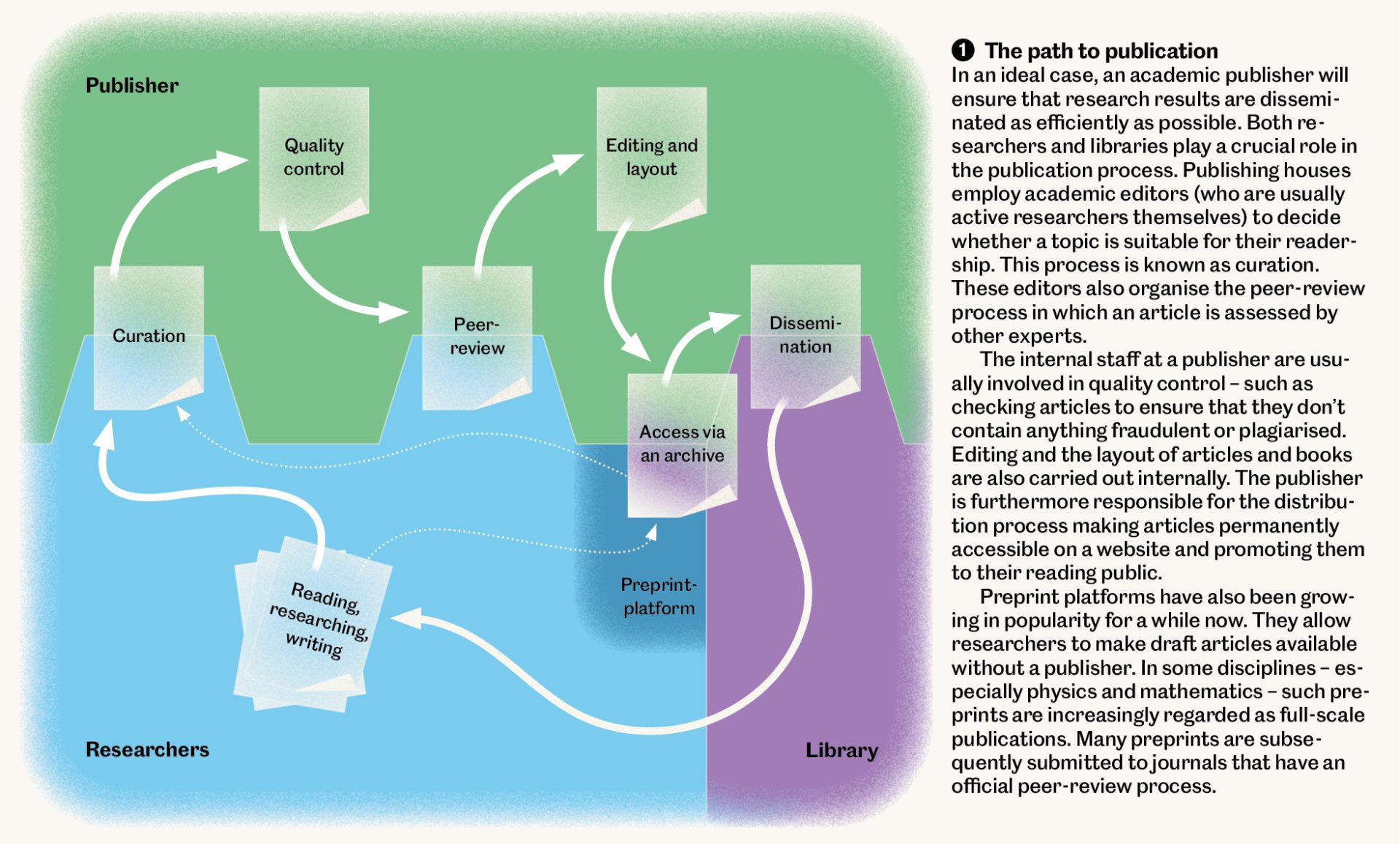
- The path of a scholarly article from the initial research via the publisher to the library – with a preprint platform as an intermediate stop. | Infographic: Bodara
A tug-of-war over the right price
In late December 2025, Swissuniversities – the umbrella organisation for Swiss tertiary institutions – announced that it had been unable to sign a contractual agreement with Springer Nature, the world’s second-biggest academic publisher. They’ve been in a ‘no-deal’ situation since the beginning of 2026. In other words: researchers in Switzerland now have no free access to any articles newly published by Springer Nature, nor have they the automatic right to publish their own articles there on open access. This state of affairs is usually covered by so-called ‘read-and-publish’ contracts whose aim is to allow scientific findings to circulate efficiently. No such contract has yet been signed.
Publishing scholarly articles down the years
1665: The journal ‘Philosophical Transactions of the Royal Society’ is launched. It offers an alternative to researchers corresponding directly with each other.
1869: The astronomer Norman Lockyer founds the specialist journal ‘Nature’, which initially prefers the swift publication of short articles without any peer review. It only introduces peer review in 1973.
1951: The businessman Robert Maxwell buys the publishing house of Butterworth-Springer, renames it Pergamon Press and turns publishing scholarly articles into a business.
1991: The platform Arxiv is put online, enabling preprints to be archived quickly.
2022: MDPI of Basle, which publishes on open access, briefly overtakes Wiley in the number of articles it publishes, thereby becoming the world’s third-biggest scholarly publisher. Ahead of it are only Elsevier and Springer Nature, Nos. 1 and 2 in the ranking respectively.
Research institutions are now locked in a difficult tug-of-war about setting the right price for read-and-publish contracts. Swissuniversities hopes that presenting a united front will strengthen their bargaining position. And it’s not just in Switzerland that there’s difficulties of this kind. Elsevier is the world’s biggest academic publisher, and from 2019 to 2023 a similar ‘no-deal’ situation pitted them against the universities of Germany, whose strategy proved successful: “The prices agreed by the German deal consortium are now considered the best in class”, says Thomas Leibundgut, who’s busy coordinating negotiations on behalf of Swissuniversities.
But in academic publishing, what really constitutes a ‘fair price’? Just what are researchers and university libraries paying for? We’ve got the answers for you here.
-
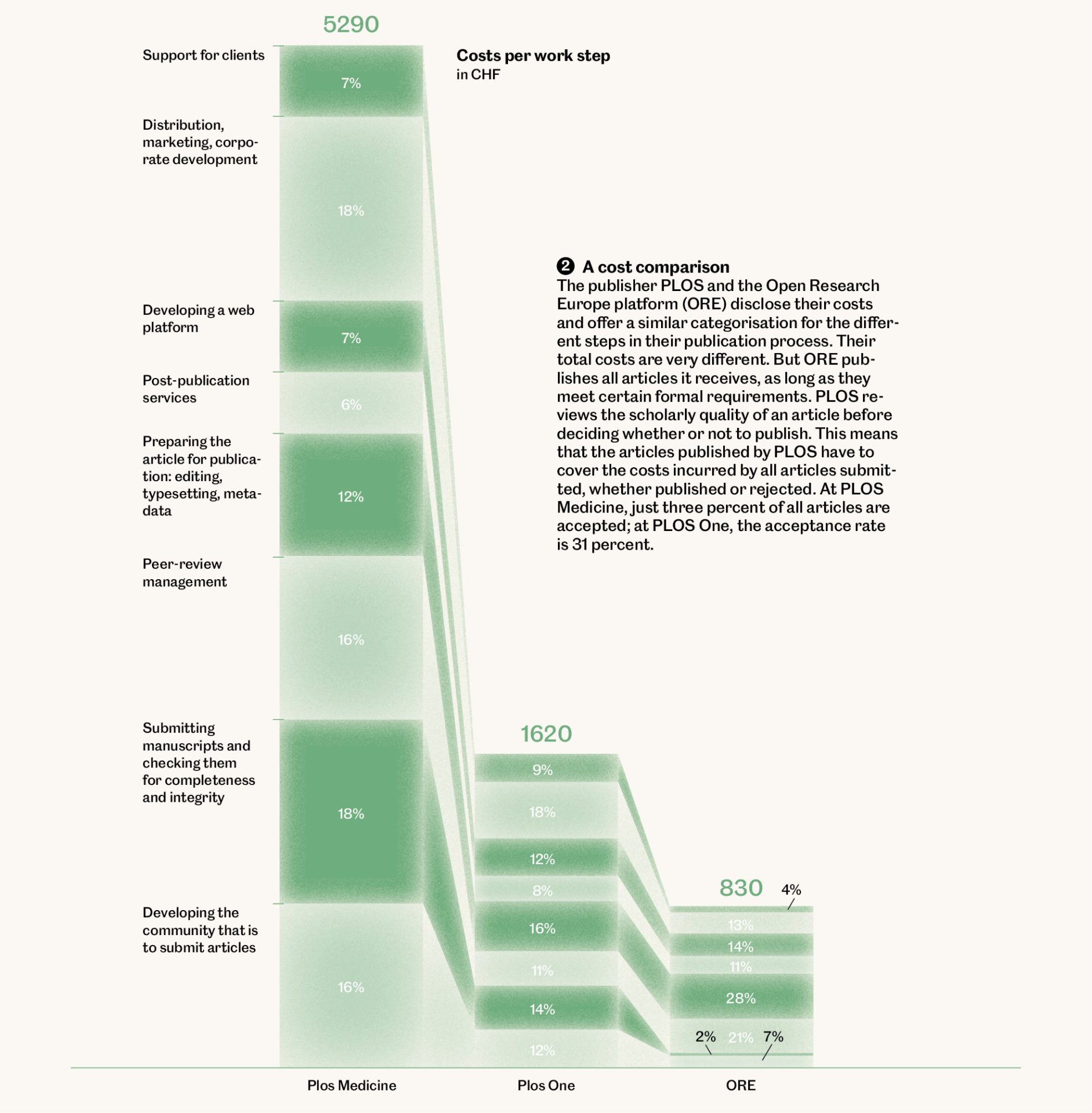
- A cost comparison for scholarly articles in Plos Medicine, Plos One and Open Research Europe (ORE). Sources: Plos Price Transparency Update 2024, Plos Research Metrics (2024), Open Research Europe Article Processing Charges. | Infographic: Bodara
What publishing activities actually cost
“The real costs and profits of publishers are very difficult to understand”, says Claudio Aspesi, a former financial analyst who today works as a consultant to universities. “Sometimes I wonder whether the publishers themselves even understand it”. They are often mixed-sector companies. Elsevier belongs to the RELX Group, which organises trades fairs and offers online databases and analytical tools for the legal and financial sectors.
Open Research Europe (ORE), a publishing platform set up in 2021, can help us get an idea of just what each stage of the publishing process costs a publisher. The European Commission pays ORE a fixed sum of EUR 870 per article. When ORE publishes an article that has been submitted, it does so as a preprint, with peer reviews added later. Every researcher who gets EU funding can publish with ORE on open access, free of charge. As of autumn 2026, this will also apply to all researchers from Switzerland.
The publisher PLOS can offer us further insights into costs. It publishes 12 open-access journals and, like most publishers, it conducts a traditional peer review before publishing an article. If it publishes an article, the researchers pay the publisher an article processing charge (APC). This is currently set at USD 1,900 and USD 6,300 for PLOS One and PLOS Medicine respectively – which is significantly higher than the fixed fee charged by ORE.
However, we can’t simply compare costs on a like-for-like basis because the APC demanded by PLOS also has to cover the costs incurred by articles that are not accepted for publication. At PLOS Medicine, for example, up to 97 percent of all submissions are rejected. But ORE only carries out a formal assessment before publishing an article. Unlike many other publishers, both ORE and PLOS publish an open breakdown of their costs according to the different work steps involved (see Graphic 2).
Thomas Leibundgut of Swissuniversities doesn’t want to comment on whether he regards the fees charged by PLOS as justified: “Most publishers don’t make their cost structure transparent. This makes it impossible to conduct any comparisons”. Nevertheless, he admits that there are legitimate reasons for the price differences between PLOS and ORE, especially when it comes to the additional services offered by PLOS such as expert, subject-based editing, statistical advice and clarifying image rights. In general, however, Leibundgut still thinks that PLOS’s fees are rather high: “After all, most of the work is done by researchers on a non-profit basis”.
-
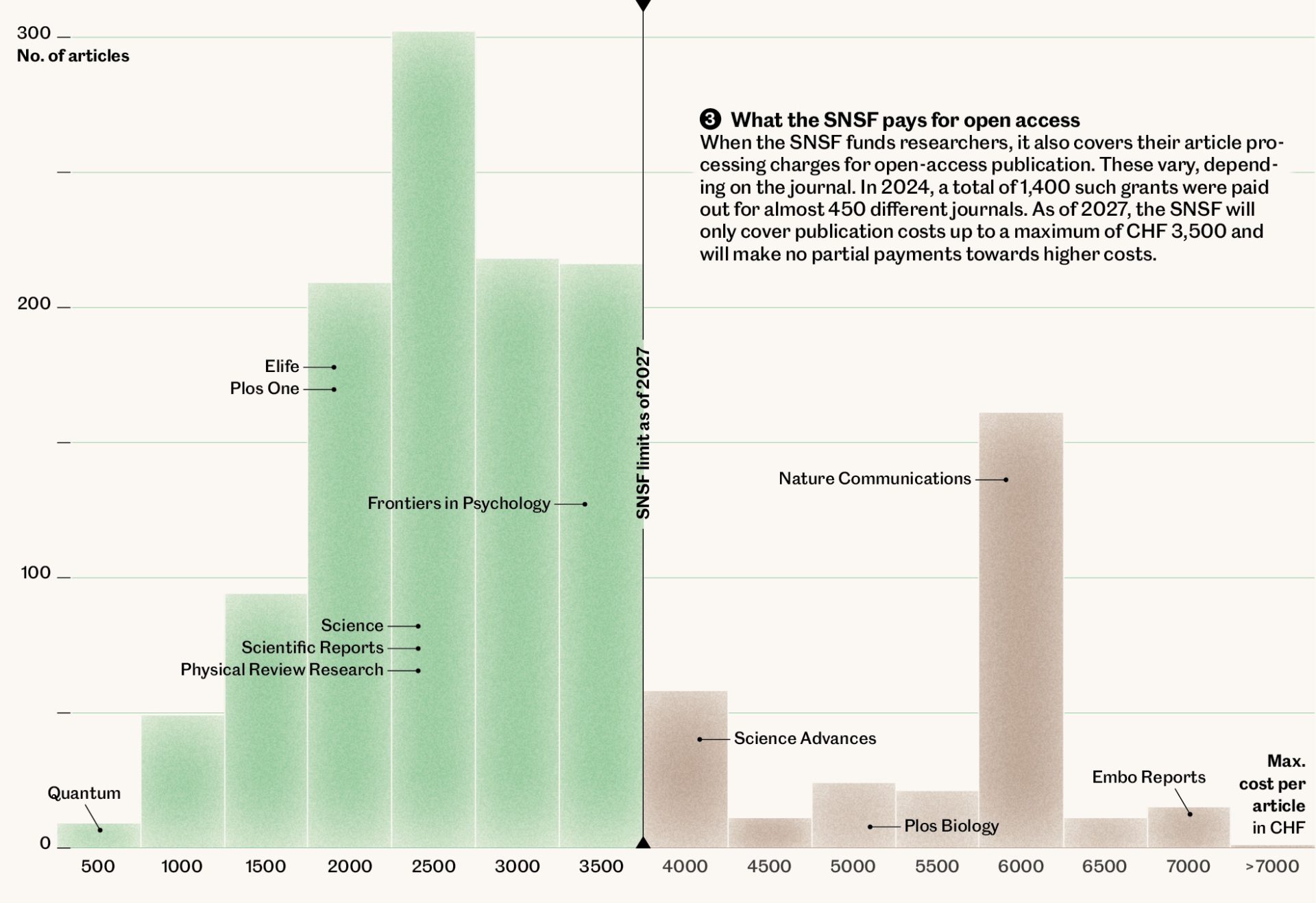
- The Article Publishing Charges (APC) paid by the SNSF in 2024. Source: Open APC / SNSF (2024) | Infographic: Bodara
The costs of accessing information
“Unrestricted access to scientific knowledge has to be a given, because society, the economy and the research community have to be able to make use of it quickly and creatively”, says Tobias Philipp, who is head of publications at the SNSF. “This could mean, for example, that a patient should be able to access first-hand medical knowledge, or that a Swiss start-up founder should be able to provide parents with easy access to the latest pedagogical insights via AI”.
The global trend is indeed towards greater openness, though most academic articles are still stuck behind paywalls. At Science magazine, for example, you have to pay USD 30 to download an article as a PDF. The same process costs EUR 29 at Nature, though this also provides a month’s access to all articles from its more than 50 journals. But staying up to date with knowledge can quickly become an expensive matter.
This is why many university libraries take out subscriptions to these journals. But not all researchers across the world have access to everything, let alone those interested parties who are located outside the research community. This is why researchers are still sending each other PDFs of articles. What’s more, platforms such as Sci-Hub often make articles available illegally.
During the Covid pandemic, publishers voluntarily made articles on the disease available to everyone. This provided for a massive acceleration in the exchange of vital information. In order to achieve a similar state of affairs in today’s ‘normal’ times, an increasing number of funding institutions are now insisting that researchers make their articles available on open access as soon as they’re published.
In 2023, almost 90 percent of articles generated from SNSF-funded research were openly accessible. But this, too, costs money. So instead of readers or libraries paying for the work done by publishers, these costs are now being borne by either the researchers themselves or their funding bodies. The costs in question are several thousand francs per article. In 2024, there were even certain cases where the SNSF paid more than CHF 7,000 for an article to be released on open access. But as of 2027, the SNSF will set an upper limit of CHF 3,500 per article. “We have to limit cost increases, and we have to spend public funds in a sustainable manner”, says Philipp. “With a limit of CHF 3,500 per article we won’t have any problems in offering researchers a very good service”.
-
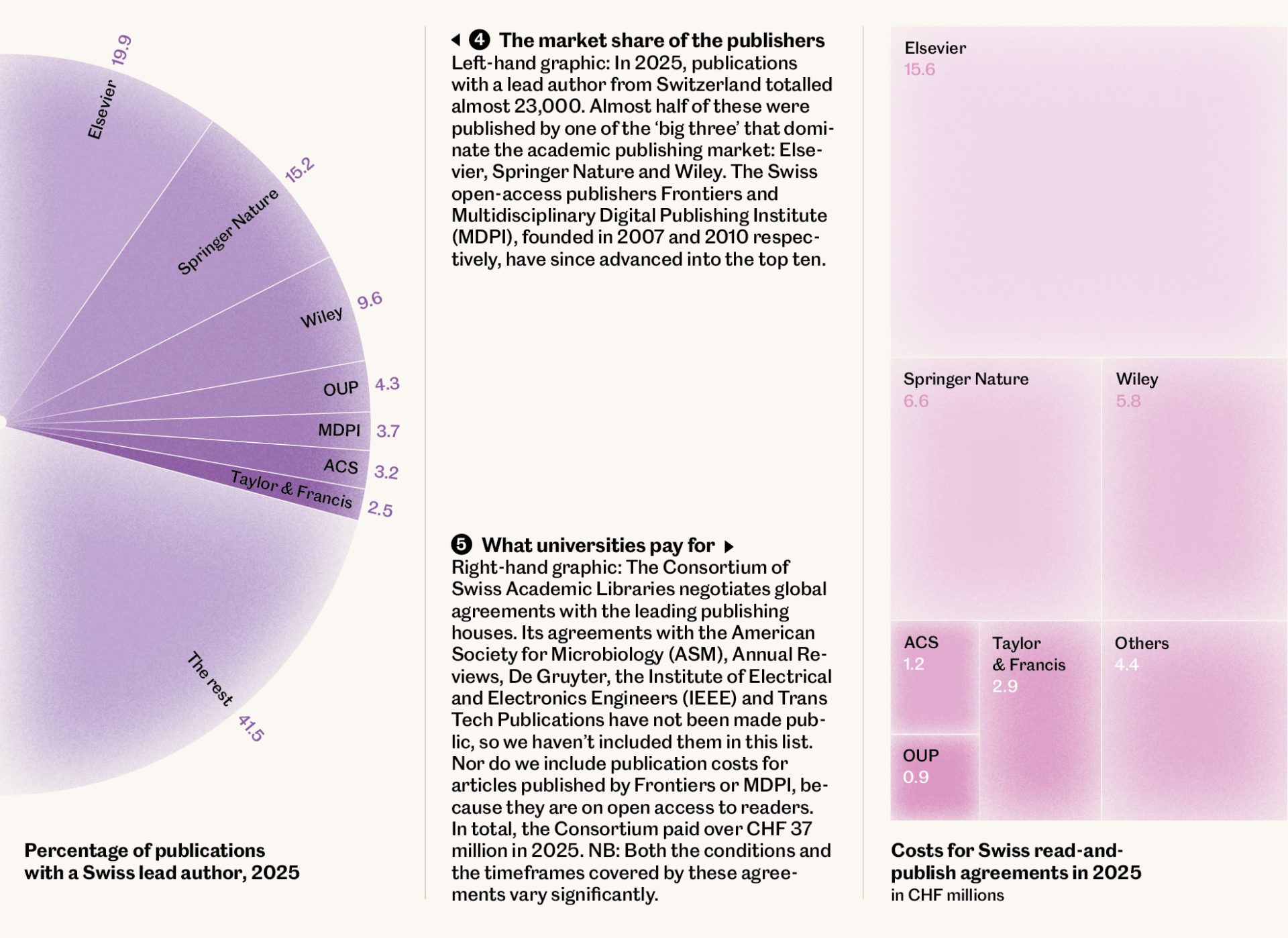
- Infographic with the market shares of the biggest academic publishers in Switzerland. And an infographic with the costs negotiated by the Consortium of Swiss University Libraries. Sources: Left, Open Alex (2025); right, Consortium of Swiss University Libraries: Contracts & Terms (2025) | Infographic: Bodara
Incredible profit margins and the importance of reputation
“Many criticise publishers for the profits they make”, says Stefan Gaillard, a doctoral student in the philosophy of science at Radboud University in Holland. “I don’t share this view. After all, I can’t blame the dealer if I pay more than I want for a car”. In a free market, clients can simply decide whether or not they want to buy something.
But the profit margins of academic publishers are less often compared with those of car dealers, and instead with those of tech companies – or, in less flattering comparisons, with those of the drug trade. In 2024, the three biggest publishers (Elsevier, Springer Nature and Wiley) reported profit margins of between 30 and 40 percent. “It is one of the most attractive businesses out there”, says Claudio Aspesi.
But when we consider just which of their services are actually worth so much money, things get more complicated. Aspesi is unstinting in his criticism: “We need publishing activities, but we don’t need publishers for that”. Gaillard has himself co-founded an academic journal – it goes by the name of ‘Journal of Trial and Error’ – and he offers a more differentiated perspective. To be sure, the price of publishing an article is justified in part by the activities undertaken by the publisher. They have software costs, they have to review and edit manuscripts, and they distribute the finished articles. All these tasks have to be undertaken by paid employees. If you want quality, you have to pay for it.
But the price also depends on the reputation of a journal. “The greater the reputation, the more you can charge for it”, says Gaillard. And that has little to do with actual publishing costs. The only costs that rise with the prestige of a journal are incurred because they attract more submissions, and dealing with them has its price.
It’s especially important for young researchers to get published in prestigious journals such as Nature and Science because it helps them to land a job at a university. This is another reason why academic publishing remains a lucrative business.
In both university appointment procedures and the publishing process, it’s a small circle of established researchers that decides whether a new colleague should be allowed to join their club. This is a process known as co-optation. “In many instances, there’s nothing wrong with that”, says Aspesi. “Organisations like the Catholic Church or the management consultancy McKinsey do the same. But science is supposed to encourage revolutionary ideas”.